Owley and Park Street
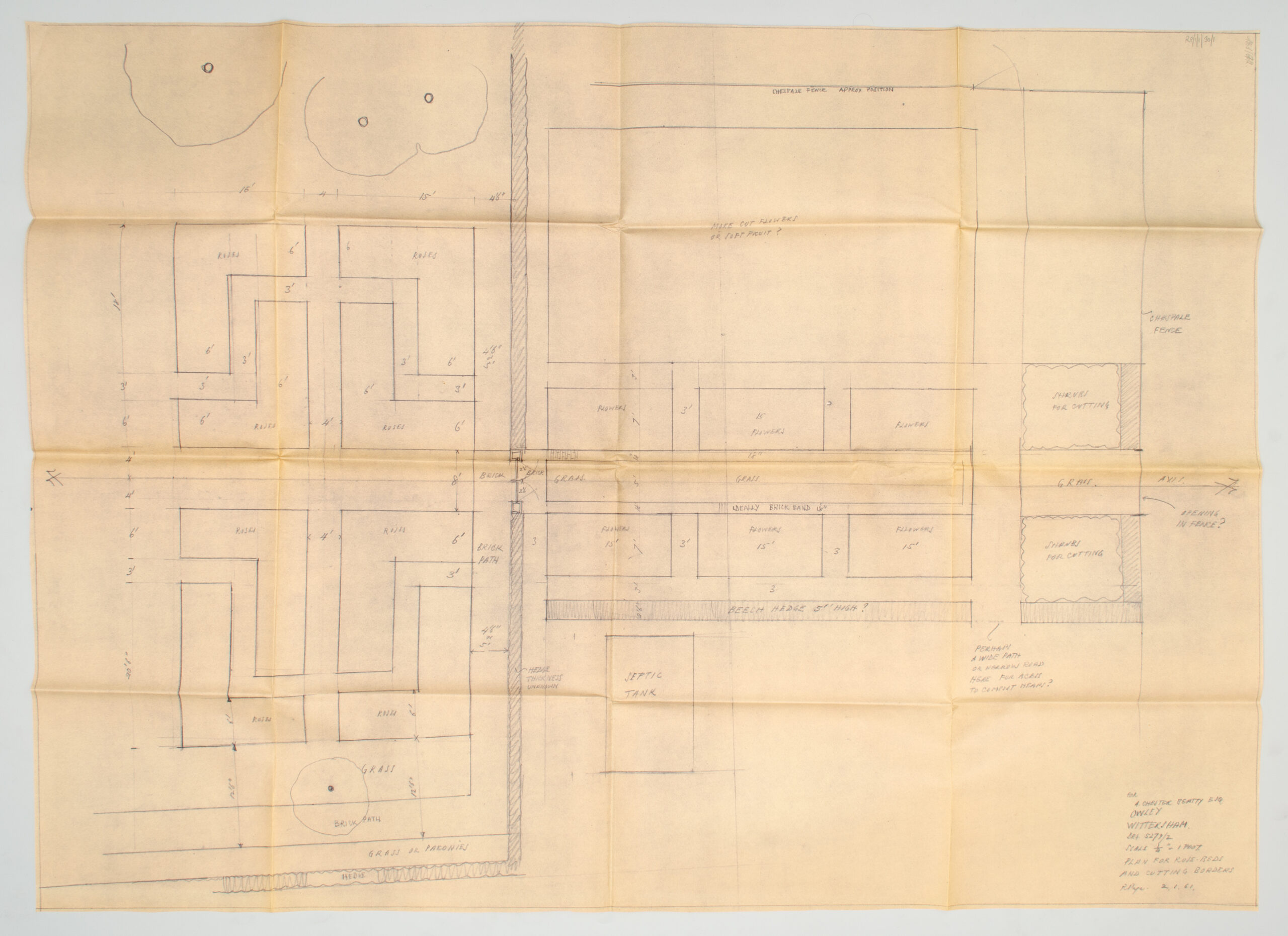
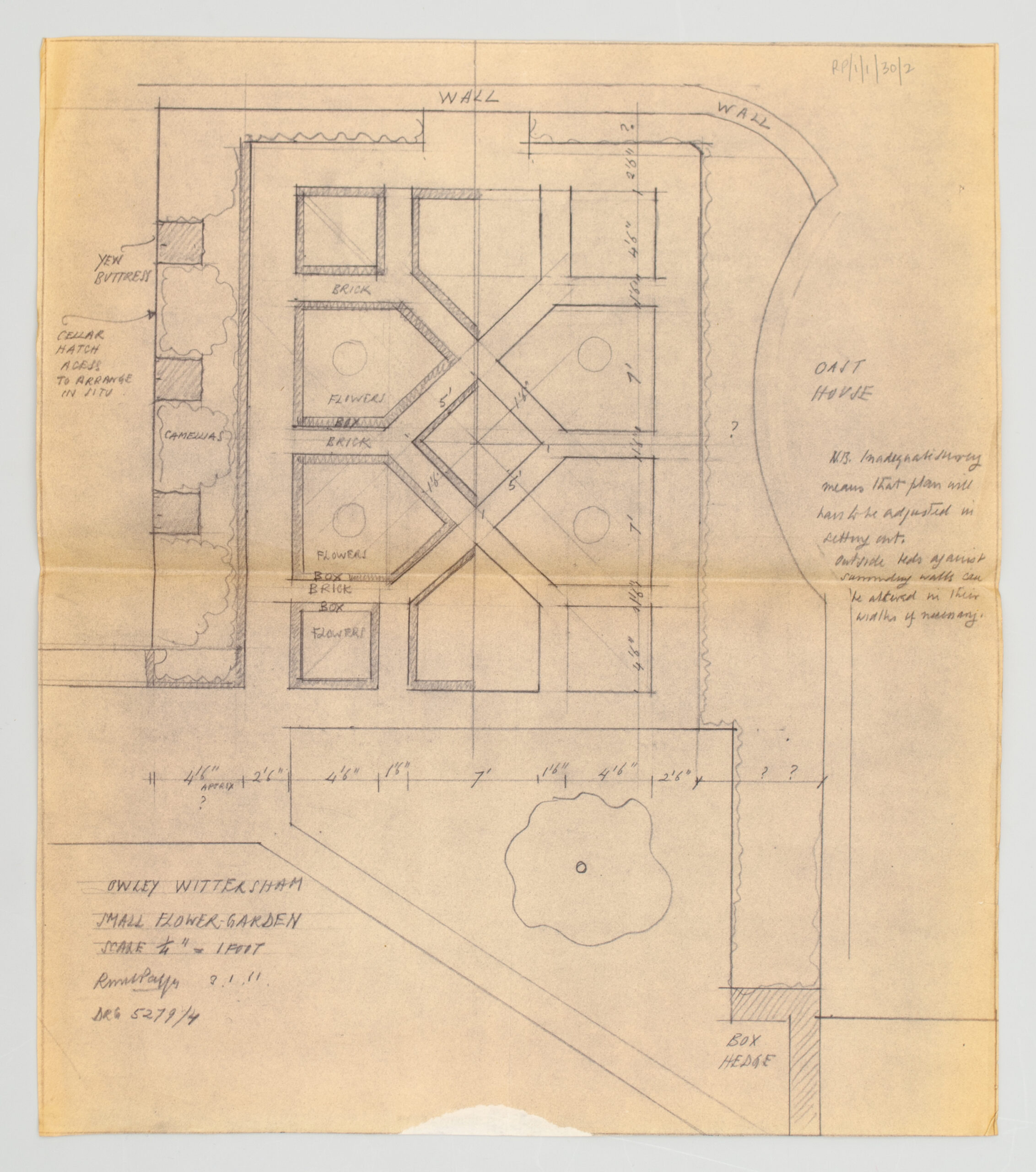
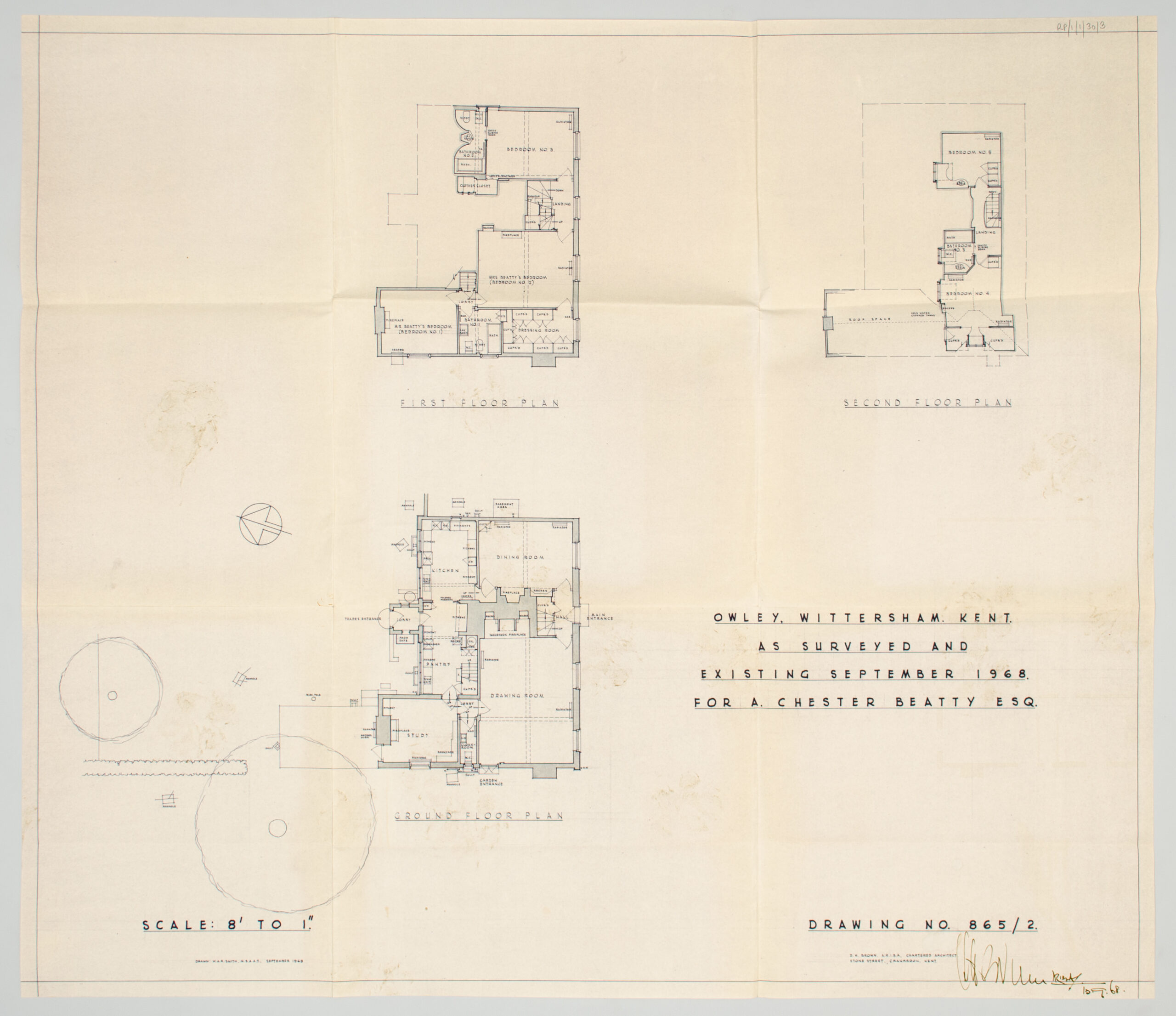
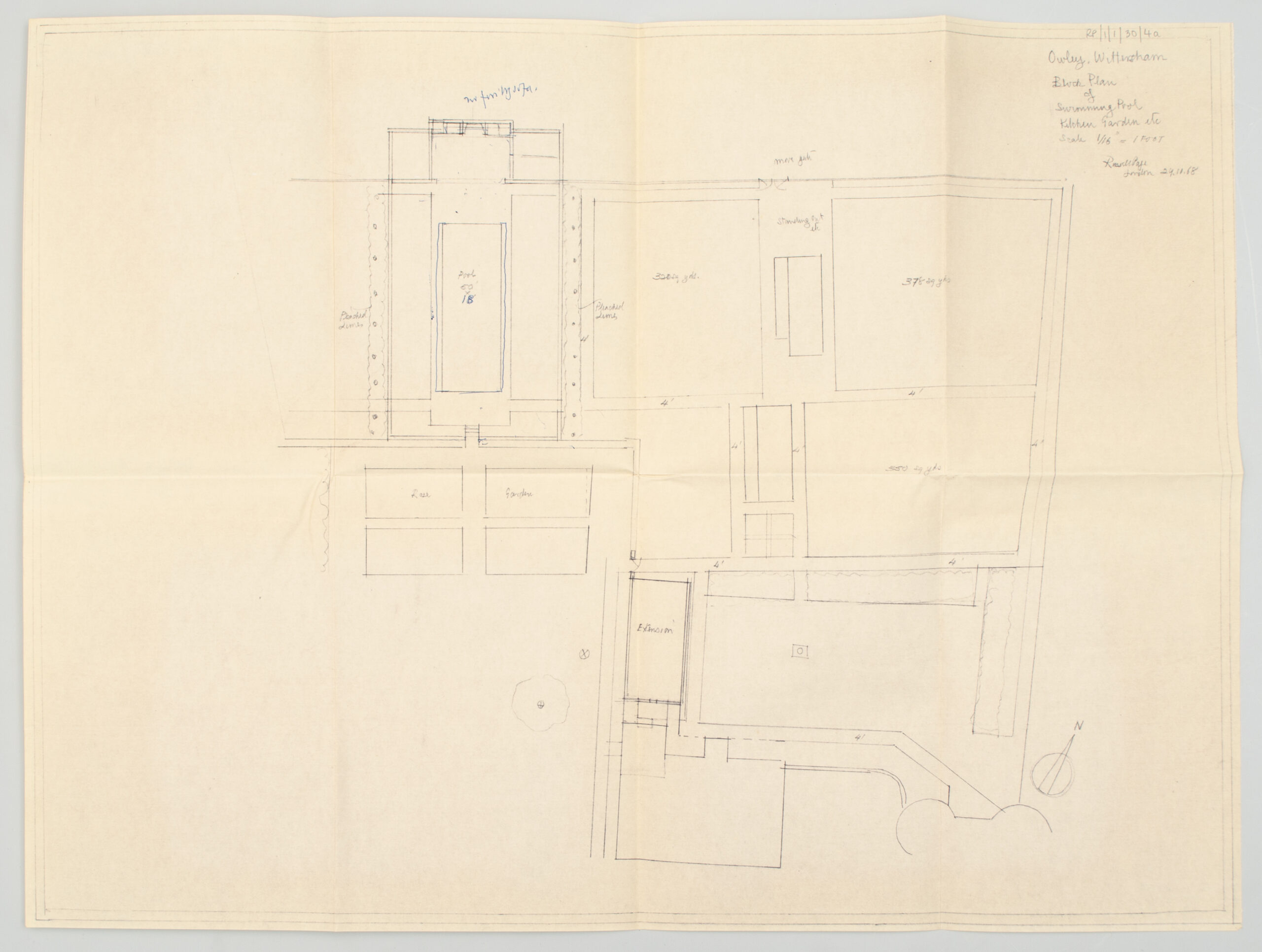
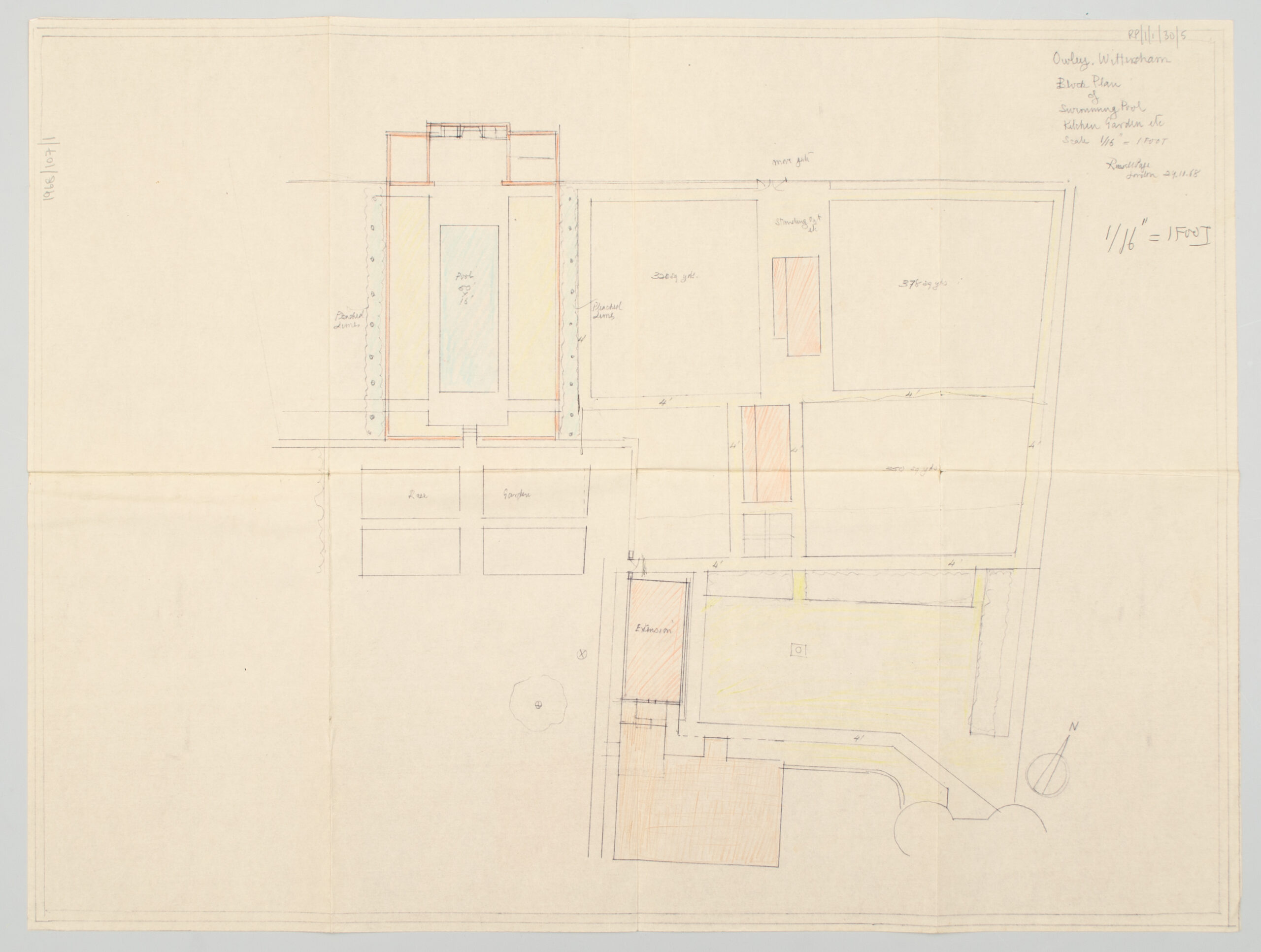
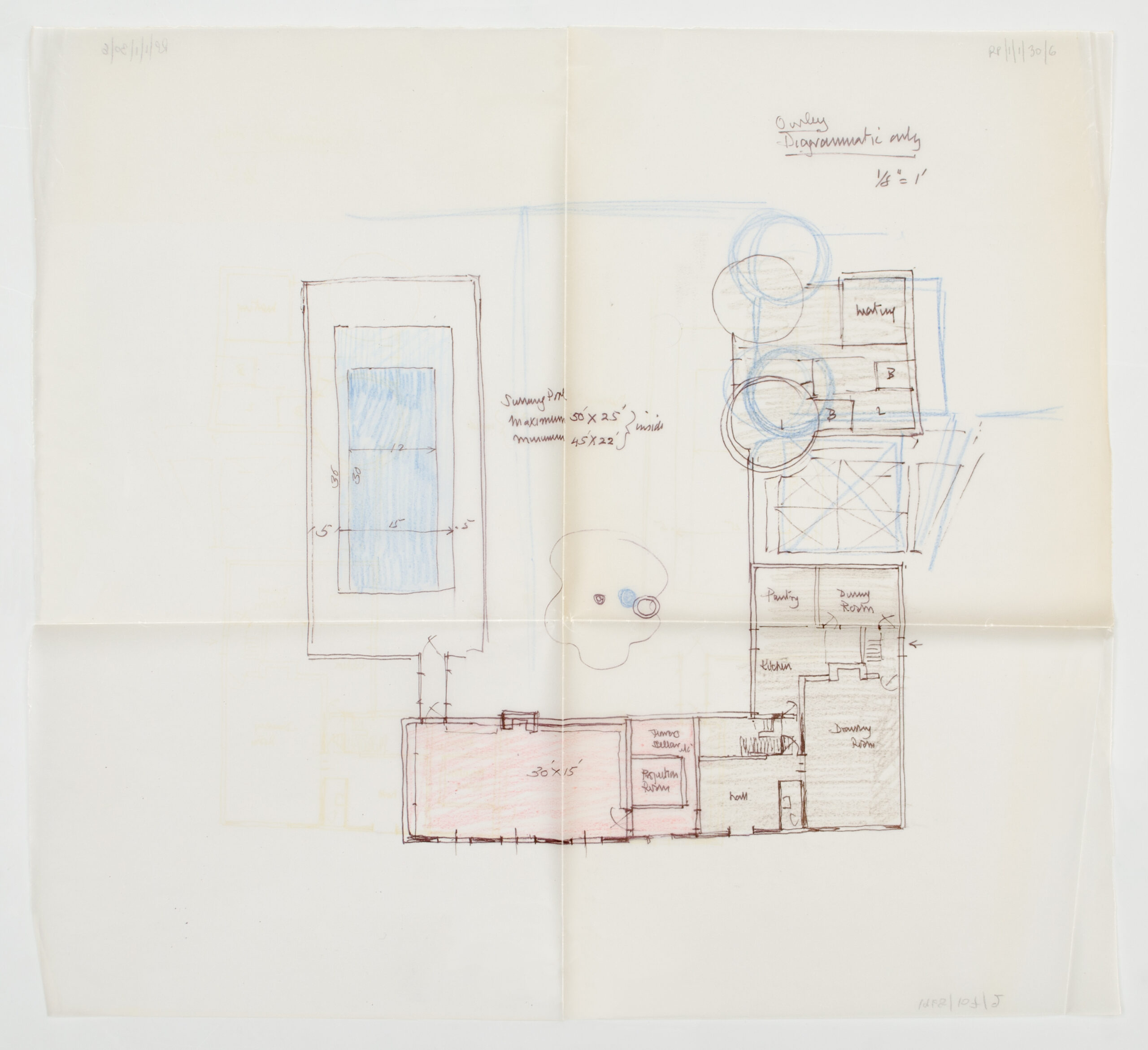
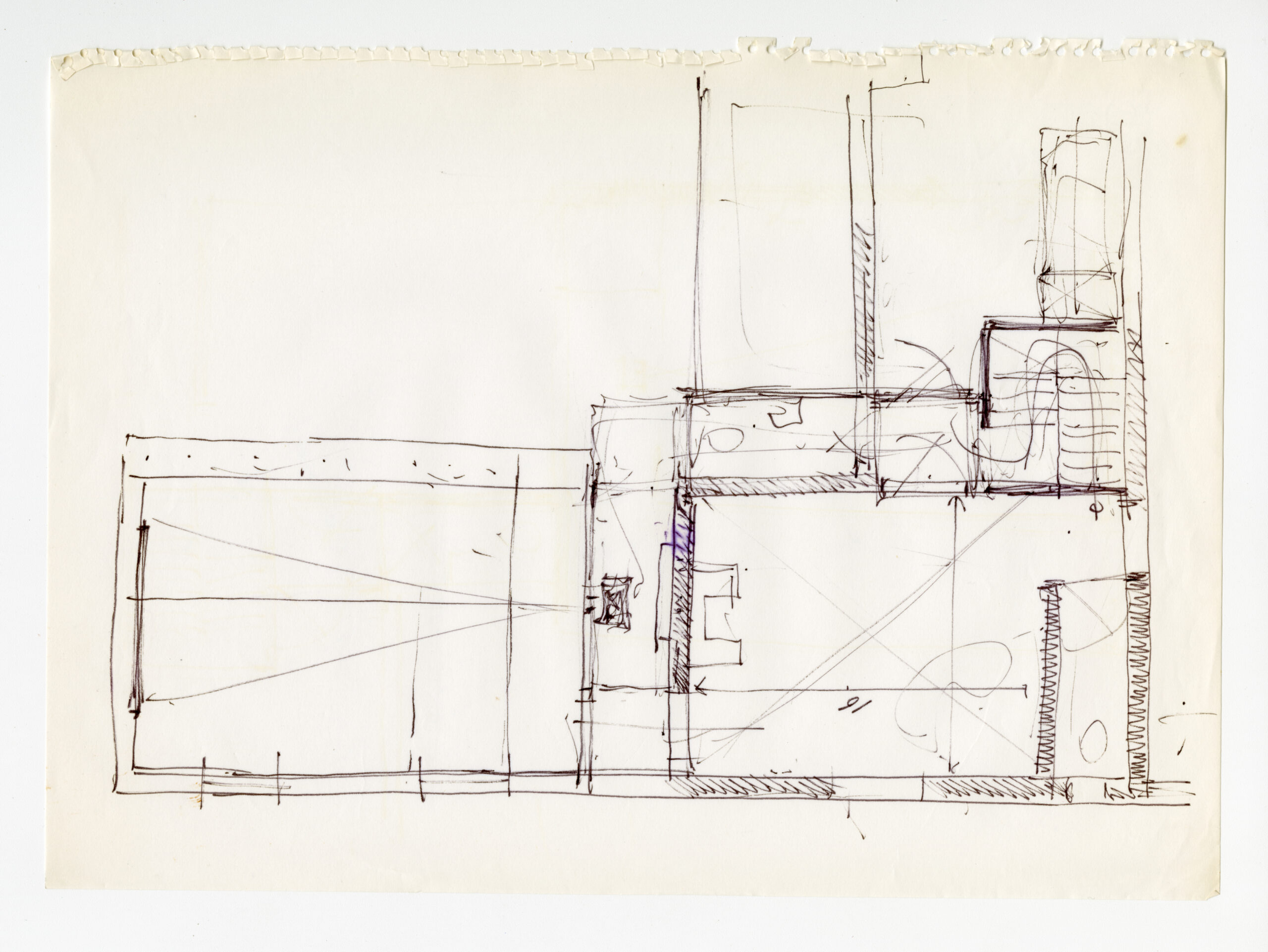
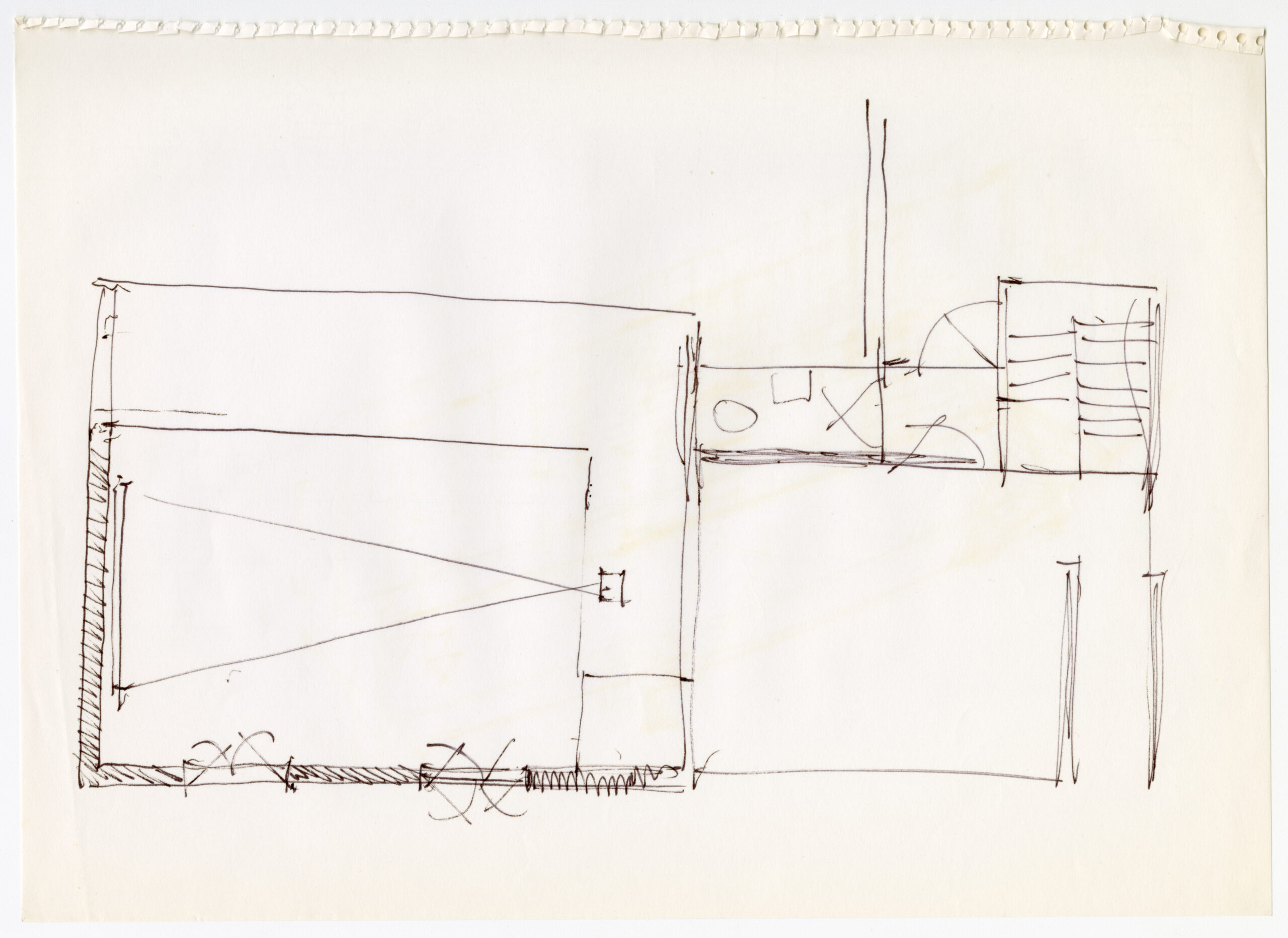
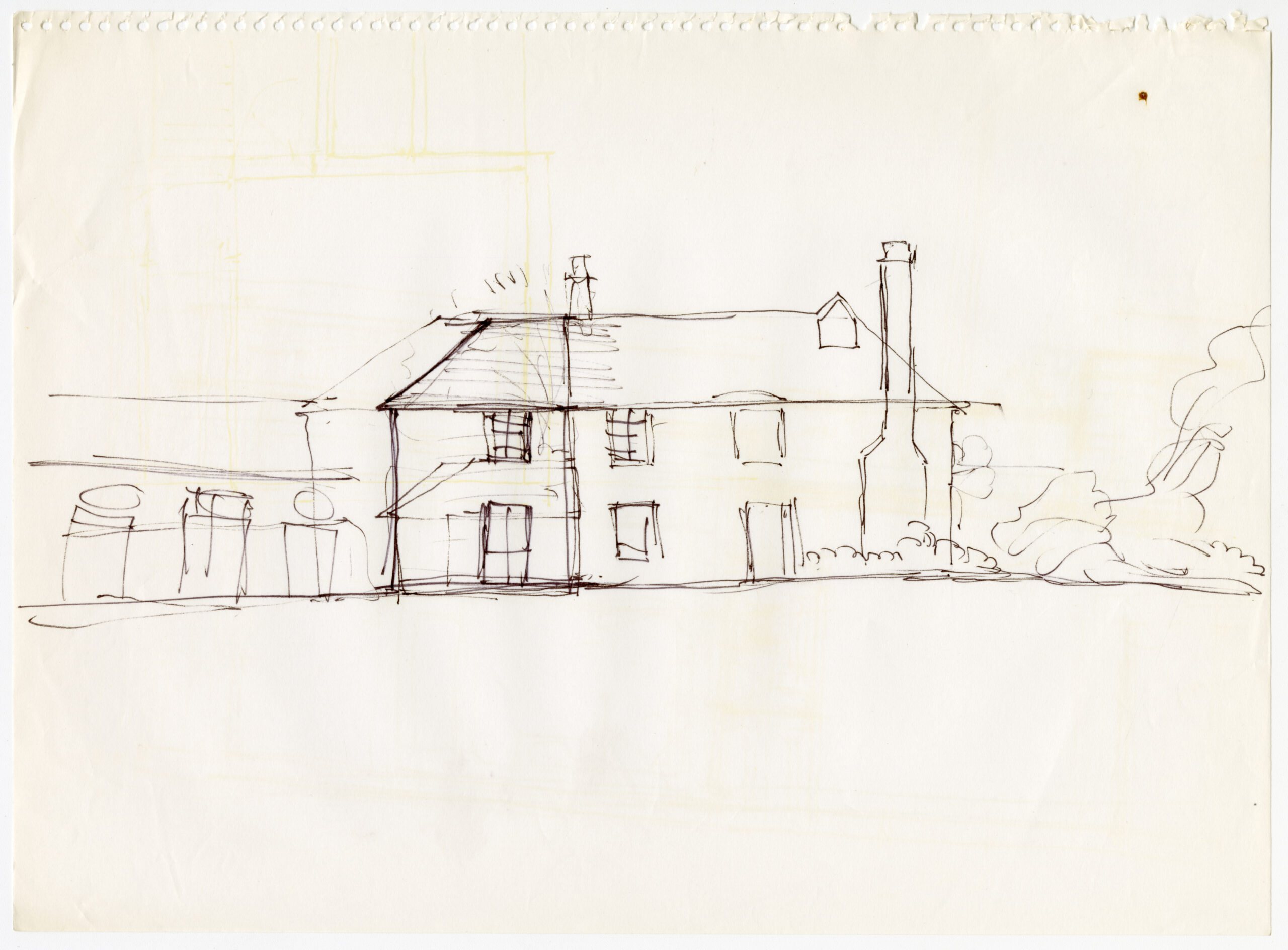
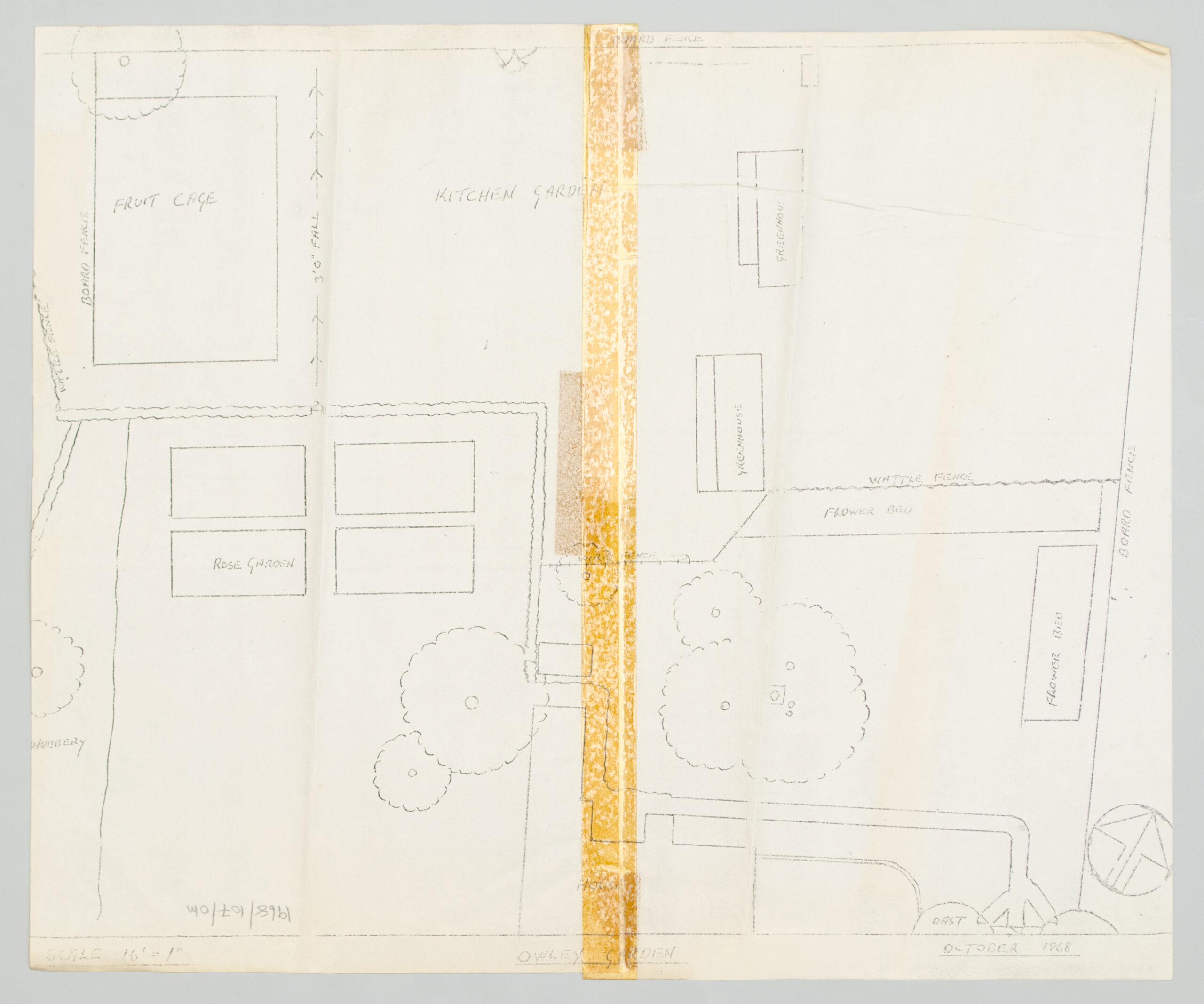
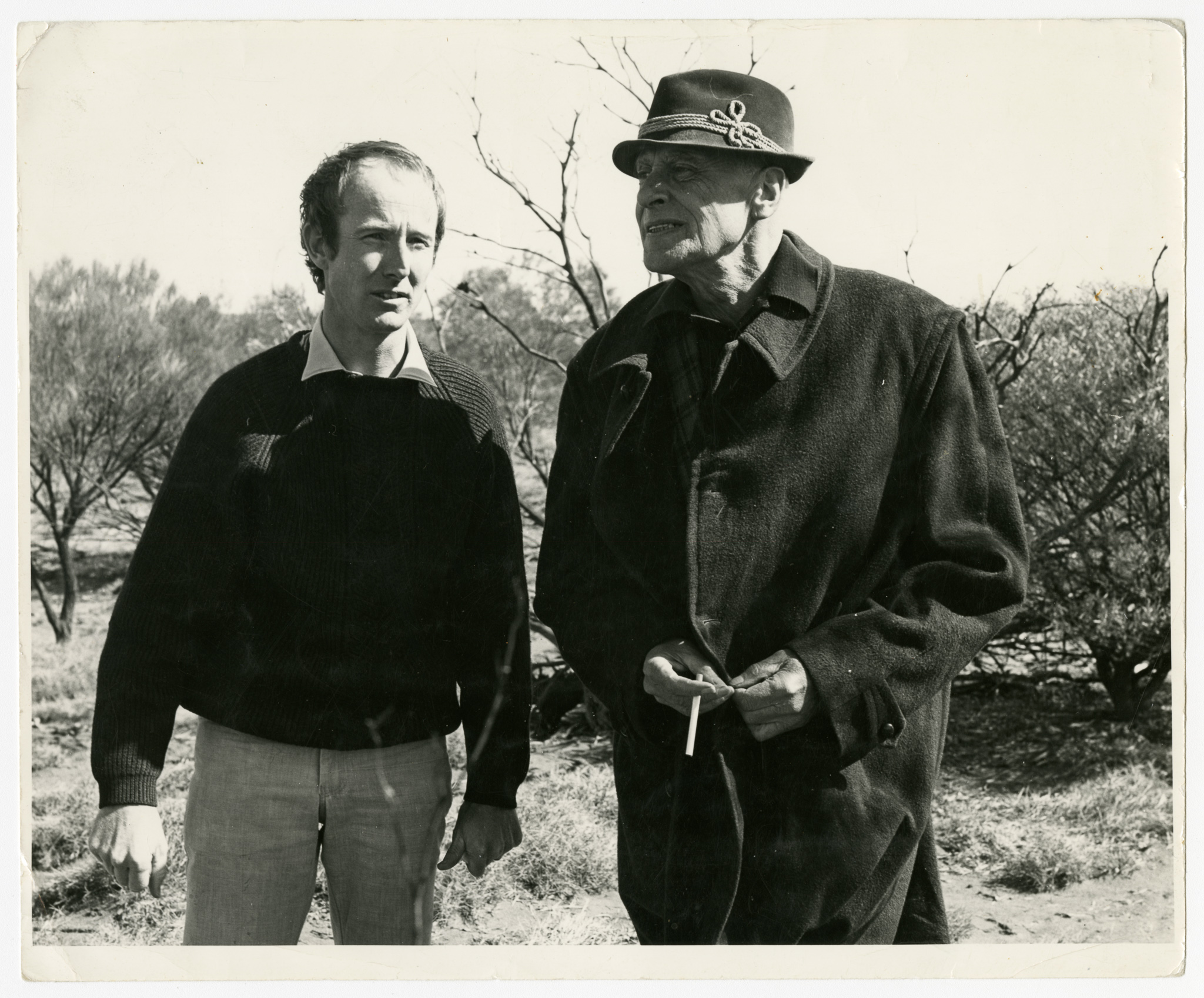
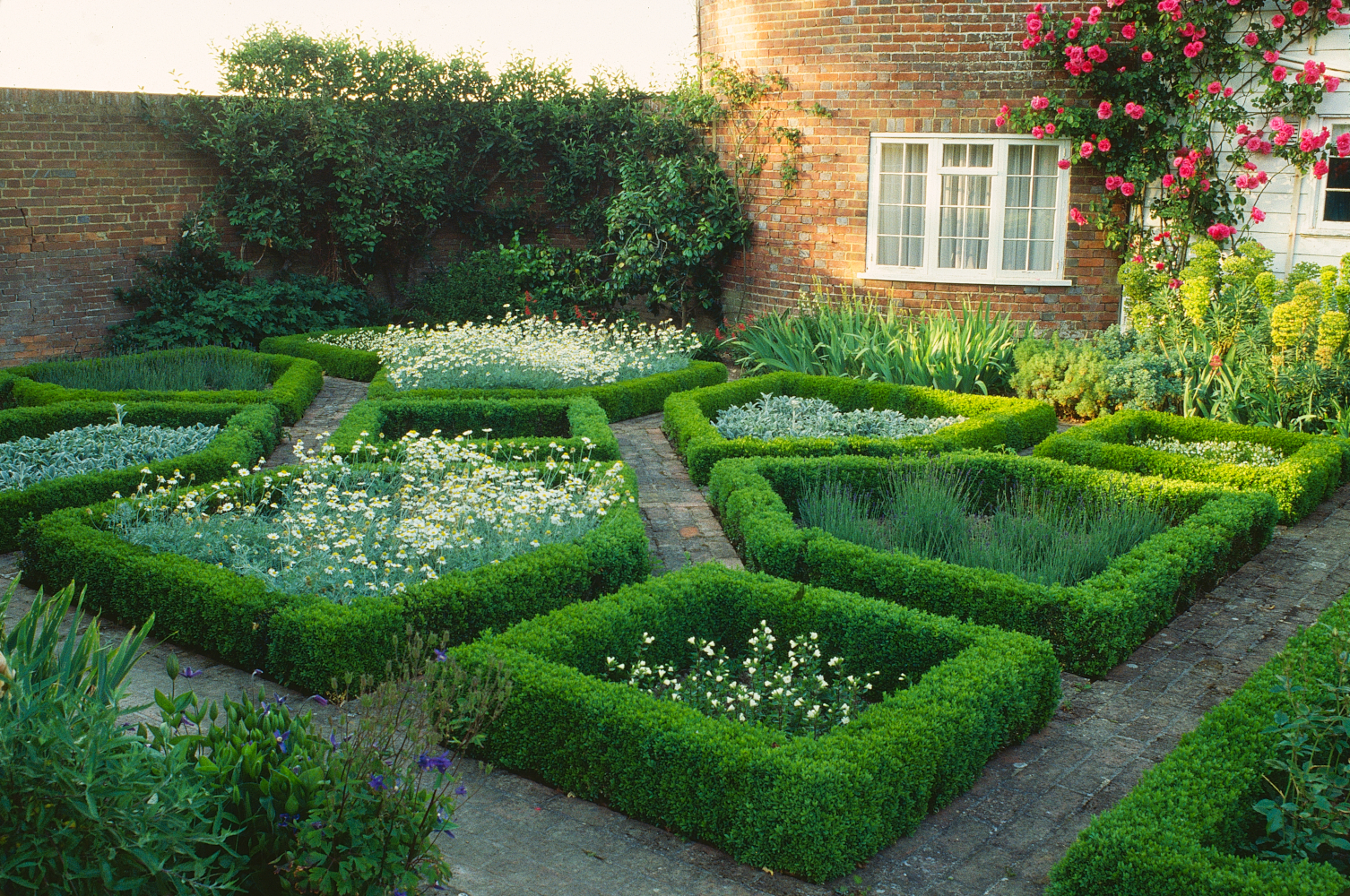
In the 1960s, Page designed two gardens for Mr and Mrs Chester Beatty: a roof terrace at their home in London, and more extensive grounds at their farmhouse in Kent.
Page could not muster much enthusiasm for roof gardens. For a designer who enjoyed nothing more than shaping the architecture of the landscape, a terrace offered little scope for imagination: ‘one is usually limited to an arrangement of flower boxes’ (Page 265). The designs for Park Street (RP/1/1/30/8 to RP/1/1/30/10) would seem to bear this out: a compact space with limited seating and flower boxes filled with bamboo and bay laurels, presumably intended to act as a screen.
Owley, a Kentish farmhouse in the small village of Wittersham, close to Romney Marsh, was an altogether different prospect. In the heart of the Kent countryside, surrounded by ancient oak trees leading to fields beyond, the garden was quintessentially English. Described by Fred Whitsey as ‘a composition in turf, trees, and roses’ (483), at Owley Page designed a blend of formal rose and flower gardens, leading to more relaxed planting beyond, with flower beds sunk into lawns.
The American-born Chester Beatty Jr, son of the renowned collector and mining magnate Sir Alfred Chester Beatty, had moved to England in 1913 with his father and sister, becoming a British national in 1937. When his father moved from London to Dublin in 1950, Beatty remained in England and took over as chairman of the family company, Selection Trust.
According to Gabrielle van Zuylen, it was Mrs Beatty who requested an abundance of roses, giving Page the freedom to plant them as he wished: ‘He used island beds of old-fashioned roses, mixed with flowering shrubs, to create a sense of space and an illusion of distance from the house’ (117). The two earliest drawings for Owley in the Russell Page archive, dating to 1961, are designs for the rose garden and a smaller flower garden (RP/1/1/30/1 and RP/1/1/30/2). Although the overall layout of both spaces is revealed, there is little in the way of information about the planting. The same is true of the other plans. A swimming pool hidden behind pleached limes is indicated, as is a kitchen garden, but not much more. Handwritten plant lists suggest that the roses were interspersed with salvias, hydrangeas, hollyhocks and peonies. Yet it remains hard to get a sense of the garden as a whole.
Page’s description in The Education of a Gardener of his views on designing borders hints at the approach he may have taken at Owley:
“In the flower garden – in contrast to the informality of the wilder part of the garden, where other considerations will come in and there will be another approach – I try to come to my planting problems as an architect. My first concern is with forms, volumes, textures and with the constructions of my plant material: then as a painter, I must deal with colour for its own sake and for the planes and recessions it will give; finally, as a gardener, I have to decide which plants I can use and in what combinations (209).”
Brief notes found in a notebook in the Russell Page archive suggest that Page would have included Owley in a planned sequel to The Education of a Gardener, along with other English gardens he designed: the Cottage at Badminton and Coppings Farm. These notes reveal very little, however: the only comments Page made about Owley referenced the pond and the heavy clay soil. A fuller description of the garden, Fred Whitsey’s 1977 account of Owley, is thus helpful in filling in the gaps:
“A courtyard between the north side of the house and some of the clapboard farm buildings, which adjoin two conical oast houses, has been turned into a box-edged parterre with paved path forming the diagonal pattern which takes over in winter. The surrounding borders are planted with mounds of green and grey rue, santolina and giant spurge, broken up with spiky plants at intervals. […] Continuing, always with the wide lawns that run down to the lake on your left, round to the south side of the house, a garden door, embowered with more climbing roses and flanked by great clumps of lavender punctuated with lilies and yuccas, looks across another stretch of lawn towards a development of the garden’s planting scheme, a great sweep of boomerang-shaped rose beds overflowing with flowers as though they really enjoyed the land that grows hops and apples incomparably. But this is to anticipate the less formal areas of the garden where it is influenced by the surrounding countryside. First there is another formal rose garden to be explored. This time the edging is composed of lavender with the central path focused on a gate through a hedge of beech which leads into the kitchen garden. […] Cross [a stream] by one of the bridges and you find a mown path following the course of the stream and running through a copse which serves as a gallery for a collection of contemporary statuary. Soon you find yourself in a series of island beds of herbaceous plants that echo in their shape the rose beds that similarly fill the opposite corner of what you might call the great south lawn. (481-2).”
Although the last of the plans dates to 1968, notes suggest that Page continued to advise on the garden in the early 1970s. The Beattys continued to live at Owley until the 1980s (Chester Beatty died in 1983, his wife in 1986; both are buried in Wittersham).
Literature
Page, Russell. Unpublished notes, undated [1970s?] (Archive of Garden Design RP/3/1/5(3 of 11)).
The Education of a Gardener. Harvill, 1994.
van Zuylen, Gabrielle and Marina Schinz. The Gardens of Russell Page. Frances Lincoln Ltd, 2008.
Whitsey, Fred. “Russell Page’s English gardens.” The Garden: Journal of the Royal Horticultural Society. Vol. 102, part 12, December 1977, pp. 481-487.
Related material in the Archive of Garden Design
RP/1/1/30/7: Owley, Notes and Plant Lists
RP/4/3/27: Four colour photographs of Mr and Mrs A. Chester Beatty’s house at Owley, Kent.
RP/3/1/9: Proposed Township in Western Australia (1972) for Chester Beatty.
Related material elsewhere
There are mounted colour transparencies of the garden at Owley in the RHS Lindley Library reference collection (PAG/2/3/10).