The painting remained with Morris and Lett continuously through their lives, perhaps because of its special status in their shared history, a record of that first summer of new life and connection. It is among the first major paintings Morris made in Suffolk. The picture moved with Morris and Lett from The Pound to Benton End. After Lett’s death in 1978 Morris started releasing his own paintings to the
Mayfair gallery Blond Fine Art, who held two exhibitions of his work in 1979 and 1981. Blond handled the sale of Arctic Tern on the Stour Estuary, as the picture’s provenance confirms, but it is probable this was following Morris’s death in 1982. So the likely conclusion is that this picture remained at Benton End for the whole of Morris’s life in Suffolk.
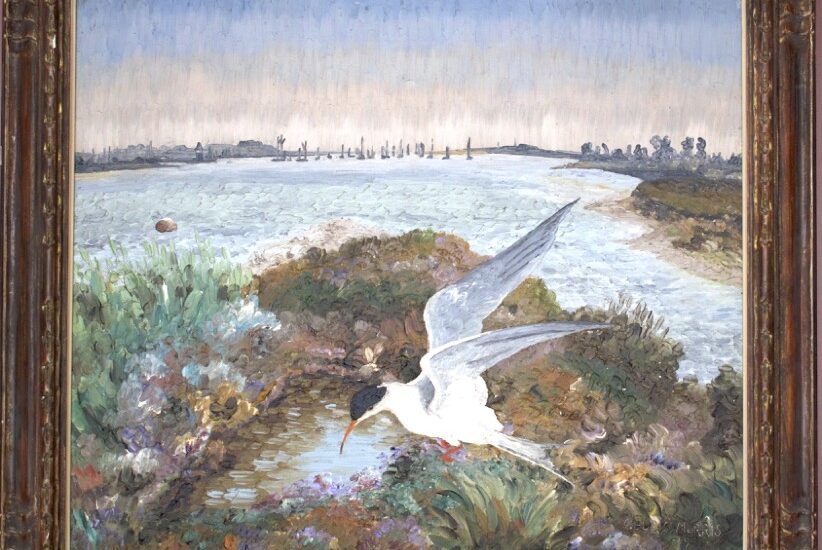
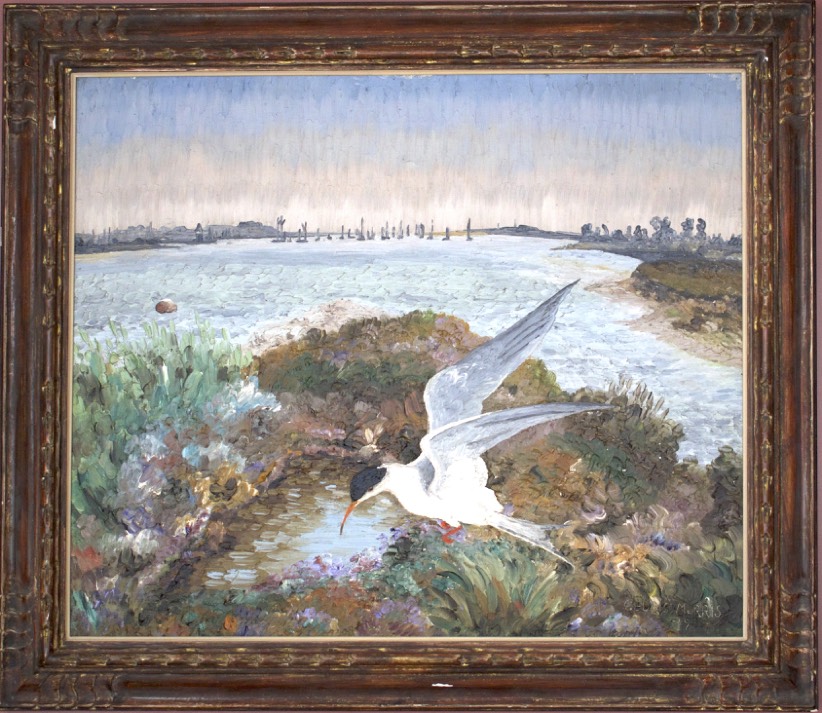
This large-scale canvas was painted from a vantage point on the southern shore of the Stour Estuary, a few miles from The Pound. The most likely location is the section of the Stour at Wrabness, famous for wild bird colonies, including Artic Terns, which is now a wildlife reserve. In the distance the twin ports of Harwich and Felixstowe are visible, while on the horizon a flotilla of Norfolk wherries spread across the water, their distinctive gaff rigs punctuating the cloudless summer sky.
Morris’s signature use of heavy impasto masterfully conveys the stiff breeze rippling across the estuary, with meticulously orchestrated brushstrokes mapping the movement of the waves. More than just a painterly tour de force, this work serves as both a natural history study and a topographical landscape.
The foreground, a vivid tapestry of coastal flora, showcases Morris’s unparalleled skill in rendering botanical still-life subjects. Morris would have sketched en plein air before refining the details in his studio. Today the Stour Estuary remains a protected Nature Reserve, safeguarding nesting birds like the Arctic Tern. It is also part of the Suffolk Coasts & Heaths Area of Outstanding Natural Beauty – a
landscape that Morris not only celebrated in his work but may have helped to preserve.
This summer the painting will be shown in Benton End: A Paradise of Pollen and Paint at the Garden Museum in London, offering a glimpse of the landscapes and living world that shaped Morris’s art and the creative life that flourished in those hallowed halls.
The work will ultimately hang at Benton End but will first be shown in the museum’s forthcoming exhibition, which explores the life of the art school and garden during the early 1950s.
Accession facilitated by Robert Upstone Ltd, the Kilroot Foundation and the Dobbs Family.