Posted on 13 May 2026

Garden History

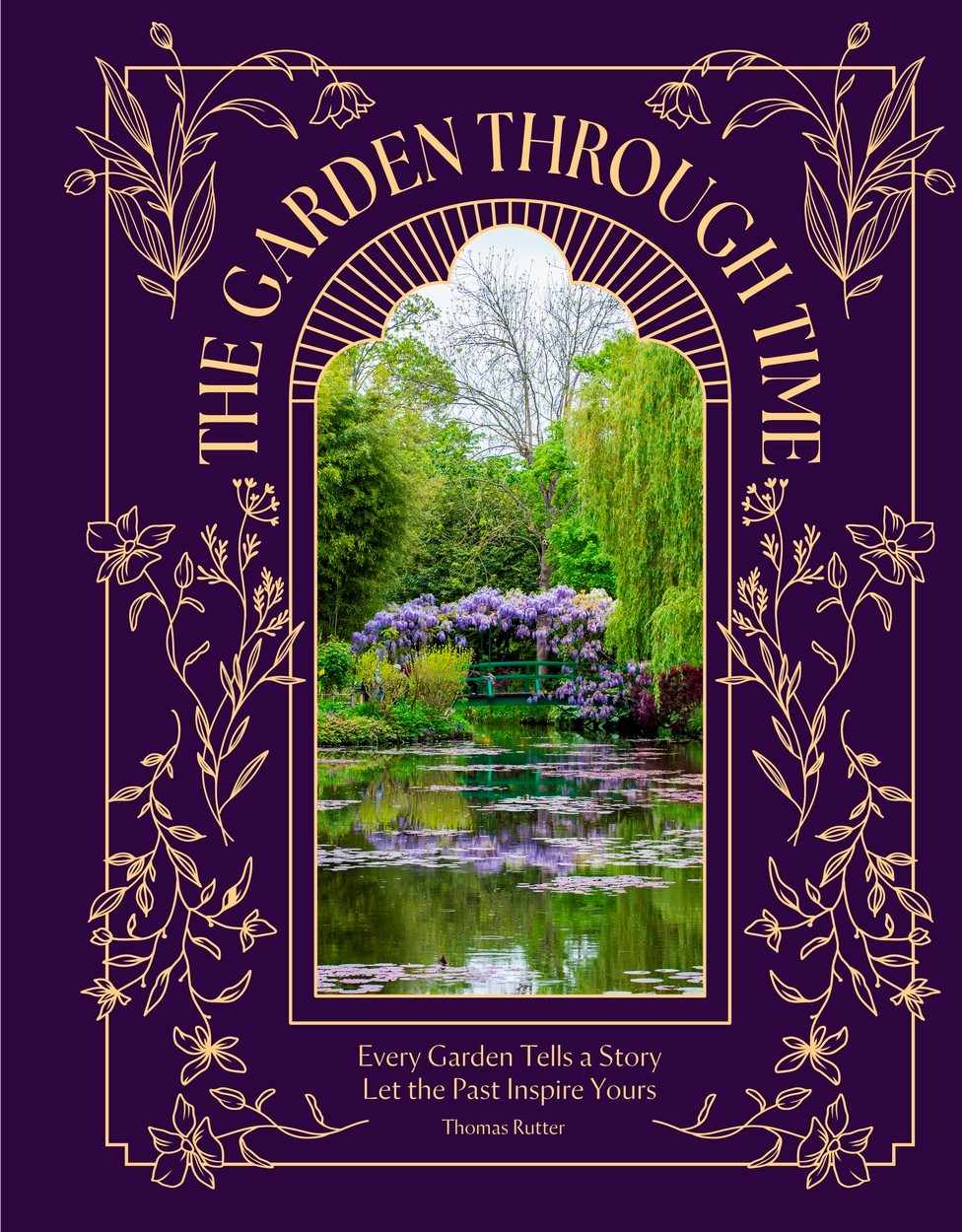
While researching his new book, 'The Garden Through Time', former Garden Museum horticultural trainee Thomas Rutter found himself returning again and again to La Foce – a garden shaped by war, beauty and the harsh landscape of southern Tuscany.

When people think of Tuscany, they usually picture vineyard-cloaked hills, cypress-lined white roads and somewhere softly bucolic, all sunlit stone and the chinking of glasses beneath pergolas. But Val d’Orcia, south of Siena, feels rather different from that version of Tuscany, which belongs more to the Chianti region further north. In high summer, the clay hills turn pale grey beneath the heat, the ground cracked and exposed, the landscape almost lunar.

It was here that I worked as a private gardener, having moved to Italy in 2022 shortly after completing the horticultural traineeship at the Garden Museum. The seasons moved quickly in Tuscany. Spring could feel fleeting before summer heat arrived with real gusto. Roses, which in Britain might flower generously for weeks, were quickly exhausted beneath the Tuscan sun. But there were advantages, too. The heat and the abundance of reptiles kept slugs and snails almost entirely at bay. Never have I seen delphiniums grow so cleanly, their leaves untouched and immaculate, even if the flowers themselves faded fast once temperatures began to climb.

Not far from where I gardened lies La Foce, where, in 1924, Iris and Antonio Origo arrived at a crumbling 3,500-acre estate surrounded by exhausted farmland. To me, the garden they made here remains perhaps the greatest in Italy. Of course, the Boboli Gardens, Villa d’Este, Villa Gamberaia and Sacro Bosco all hold their own, but it is La Foce I return to most often when I think about my time in Italy.

La Foce, photo by Thomas Rutter

What fascinated me while researching my new book, The Garden Through Time, was that La Foce was never simply a garden project. Iris Origo had grown up between England and Florence, spending much of her childhood at the Villa Medici in Fiesole, surrounded by the great traditions of the Italian Renaissance garden. She understood beauty and formality intimately. But La Foce was an entirely different undertaking. The Origos, newly married and armed with Iris’s considerable inheritance, did not come to Tuscany searching for somewhere merely beautiful. They arrived with an almost improbable ambition: to transform this harsh landscape of eroded clay hills into fertile farmland, olive groves, vineyards and wheat fields.

In her memoir Images and Shadows, Iris later wrote: “We knew at once that this vast, lonely, uncompromising landscape fascinated and compelled us.” Working in that landscape myself, I understand exactly what she meant. The Val d’Orcia is severe, but deeply magnetic, too.

Before terraces, cypress avenues or wisteria-covered walkways came into the picture, the Origos focused on survival and regeneration. The region was desperately poor. Roads were built, schools established, irrigation introduced and dams constructed to slow the erosion stripping the hillsides bare. Tractors replaced oxen carts. A Montessori school was established for local children. Over time, the estate expanded from 25 farms to 57. La Foce became not simply a private estate, but an attempt to bring prosperity to this small corner of Tuscany.

The garden itself came later, shaped with the help of the British architect Cecil Pinsent, whose Anglo-Italian style balanced Renaissance structure with the softness of English planting. Water was initially so scarce that the garden remained little more than a small refuge close to the house. Only later, after funds from Iris’s American grandmother allowed water to be diverted from a stream could the garden truly expand.

Of course, La Foce has all the hallmarks of the Italian garden tradition: red geraniums spilling from aged stone urns, lemons in terracotta pots, perfectly clipped box hedging, faded ochre plaster walls, old statues, rosemary, lavender and long wisteria walkways humming with bees in spring. But there is something more than beauty here. The story behind the garden lingers just as strongly as the planting itself.
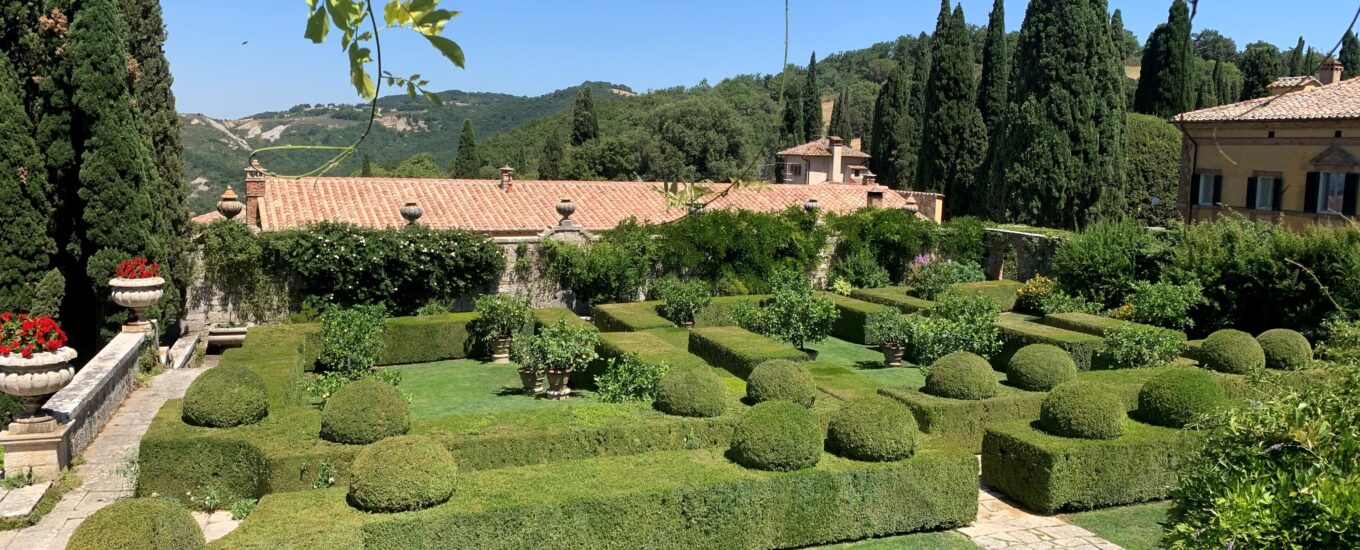
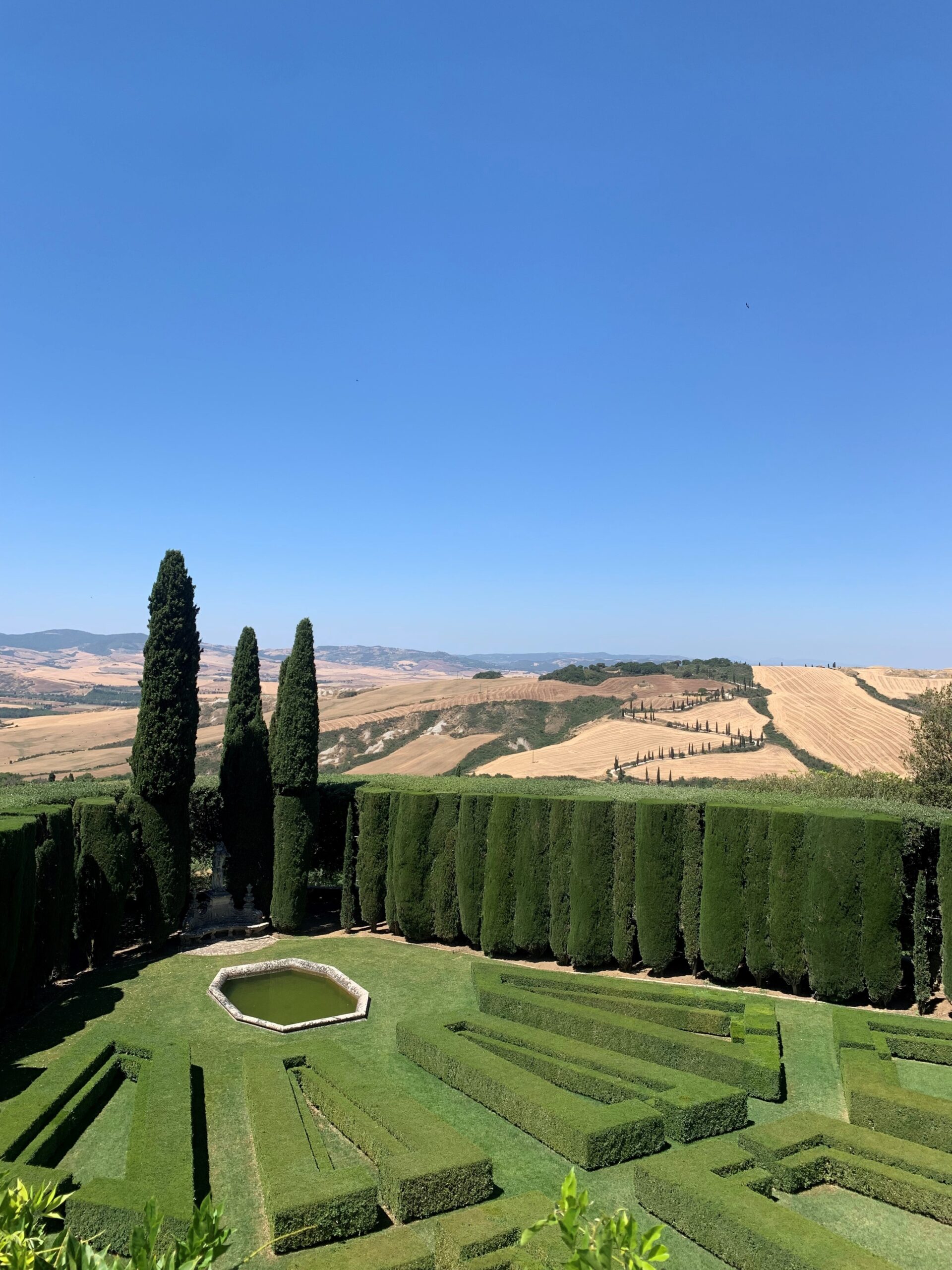
What Pinsent understood, perhaps more than anything, was that the surrounding landscape was part of the composition. The garden never attempts to shut out Val d’Orcia, but rather frame it. The main terrace is almost arrow-like in shape, directing the eye outward toward the folds of the countryside and, always in the distance, Monte Amiata, the extinct volcano whose silhouette dominates the valley. I looked toward that mountain every day whilst gardening there. In the early mornings, before the heat settled across the land, it appeared hazy blue in the distance.

During the Second World War, La Foce became a refuge. In War in Val d’Orcia, Iris documented the quieter anxieties of life under Fascism: shortages, fear, uncertainty and silence. Refugees passed secretly through the estate, hidden briefly before moving onward again.

Perhaps that is why La Foce stayed with me more than many other gardens I visited in Italy. It is not simply beautiful. It carries the imprint of people and history. Gardens, like books or buildings or museums, tell us something about those who made them: their ambitions, fears, obsessions and kindnesses.

Today, La Foce remains in the hands of the Origo family, cared for by Iris’s daughter Benedetta and granddaughter Katia Lysy. And still the garden looks outward across the hills of Val d’Orcia, beneath the vast blue shadow of Monte Amiata.

The Garden Through Time, by Thomas Rutter (Hachette, £25), brings 45 of history’s greatest gardens to life in rich storytelling and illustration, including Villa La Foce. It is available from bookshops now.  

Follow Thomas on Instagram: @thom_rutter