Dr Patricia Hardy, guest curator of Benton End: A Paradise of Pollen and Paint
When deciding upon the six ‘characters’ who would meet at Benton End at an imagined event we quickly alighted upon the artist, Joan Warburton (later O’Malley) (1920-1996). Arthur Lett-Haines, the co-founder with Cedric Morris of the East Anglian School of Painting and Drawing, based at Benton End from 1940, with his determination for word play, nicknamed Joan Warburton, ‘Maudie’ or ‘Maud’ from Tennyson’s 1855 poem, Come into the Garden, Maud in which the narrator waits by the garden gate all night for Maud to finish dancing and meet him, and this nickname stuck with her throughout her life.
Often overshadowed by other Benton End students, Warburton had a successful artistic career with fourteen solo exhibitions between 1948-92, and many group shows including the Royal Academy Summer exhibitions from 1946-70. So it seemed appropriate to display her works with those of her teacher Cedric Morris at Benton End, and bring her into the spotlight again.
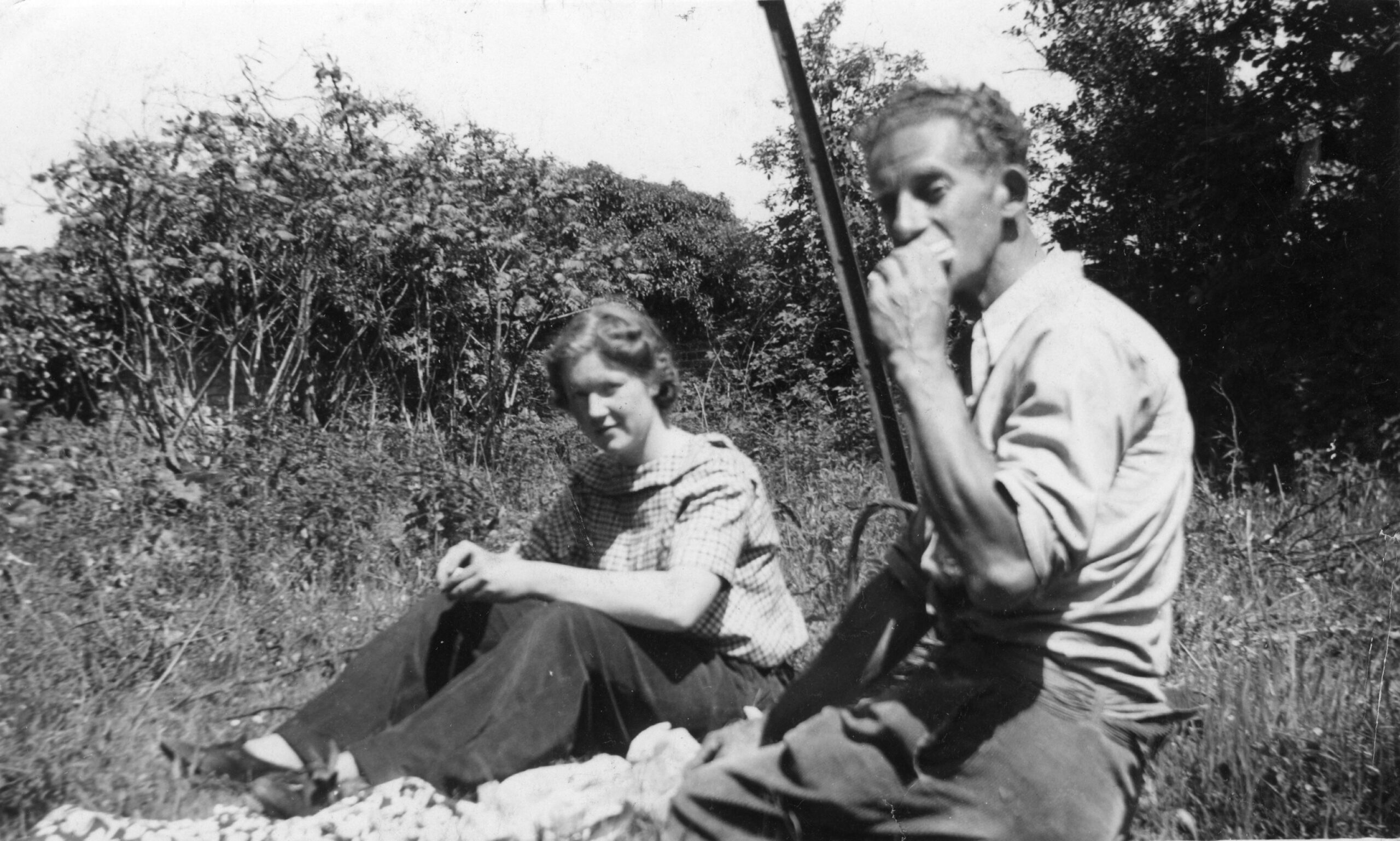
We don’t hear Warburton’s voice in the account of reminiscences by Benton End students in Benton End Remembered published after her death (although she is cited by students such as Denise Broadley who recalled that Warburton said they never did any work at Benton End) but her unpublished memoir at Tate Archive called A Painter’s Progress: Part of a Life 1920-1984 gives a vivid account of her time at Benton End together with albums of photographs. Warburton wrote that it was a delight to work with Morris in the garden and for her this period was a magical time. In the exhibition we have tried to convey that delight by displaying an evocative photograph of Warburton sitting beside Morris in the garden rather timidly glancing at the camera but with a look of undisguised pleasure on her face.
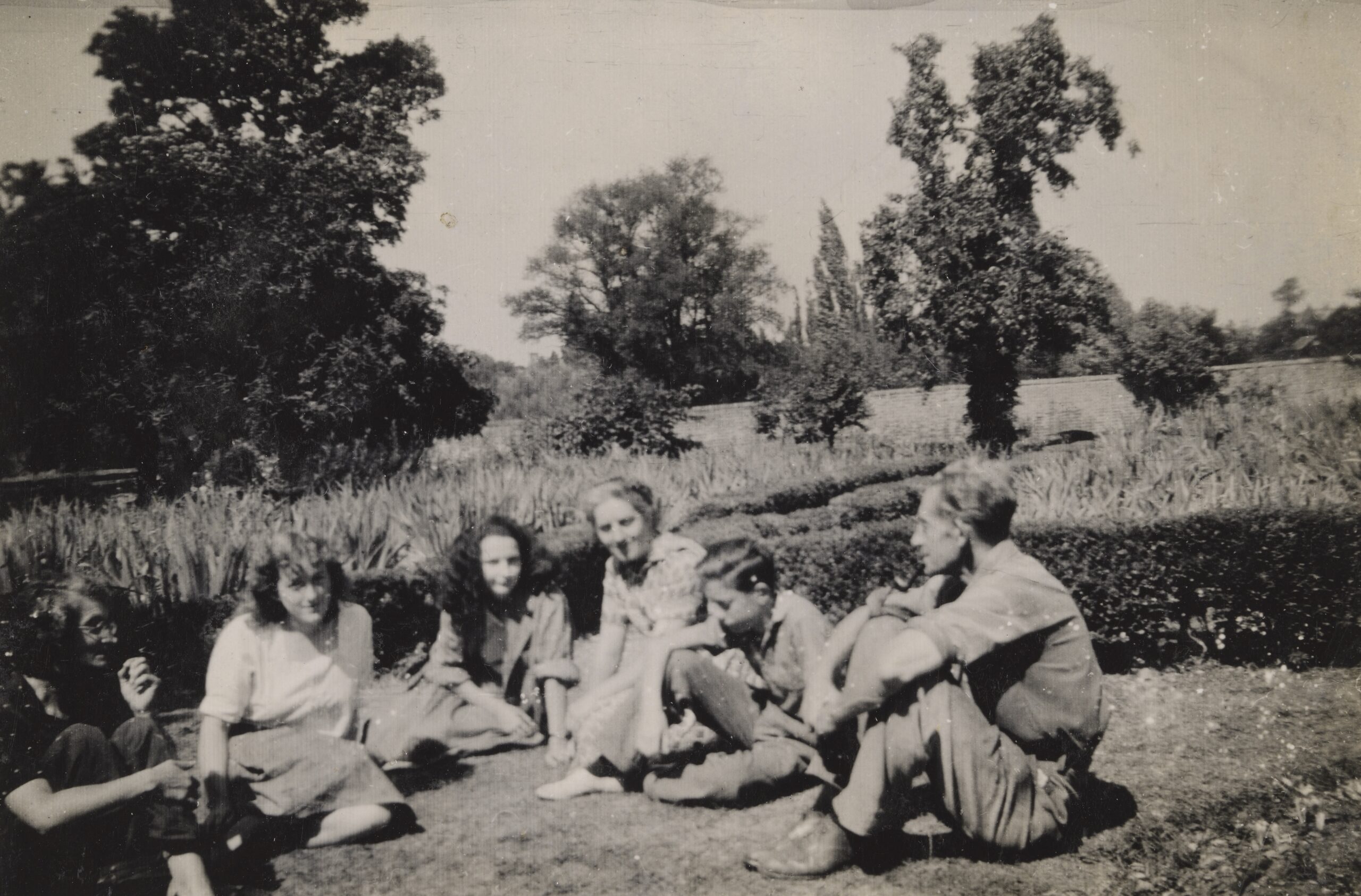
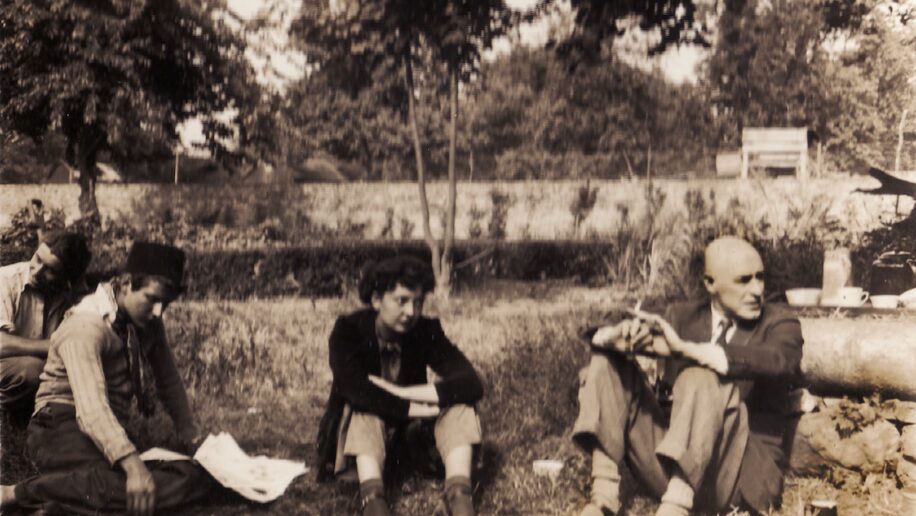
In her obituary in The Independent in August 1996, Warburton is described as physically imposing: tall and blonde, standing out in company for her laughter and handsome Nordic looks. And it is her appearance and vitality as well as her obvious artistic talent which is shown in the large banner of Warburton in the nave in which she looks like a 1940s screen goddess. Her presence continues in the exhibition space itself with the wartime photographs of her and other students like Bettina Shaw-Lawrence, Denise Broadley, Robert Davey and Lucian Freud enjoying a summer’s afternoon in the garden at Benton End.
For, not only is Warburton an interesting character in her own right, she is important to the narrative of the exhibition. She was present at Benton End from its outset in 1940, her successful career shows the influence of Morris’s interests and teaching, and she links the five other ‘characters’. She, for instance, illustrated Elizabeth David’s cookery books and lived near her in Halsey Street in Chelsea so they would visit each other frequently, and she continued to visit Benton End after her marriage to Peter O’Malley and move to London in 1945.
In the exhibition are two quickly created pen and ink drawings, one of Morris and one of Freud, both by Warburton produced at the School. She was close to Morris and this rare drawing (for he did not like to be sketched) of 1940 captures his essence in a few quick strokes. And she was also very close to Lucian Freud in these early days, as his letters to her record, ‘Hoping this finds you as it leaves me, art, art, art. All my love Lucio’ so her insights and indeed photographs (she usually seems to be the person behind the camera) into this early relationship are hugely valuable. In her drawing of Freud, she shows him palette in hand, in front of a large mirror in the studio at Benton End with the text of ‘the artist at work’.
Several of her paintings are displayed in the exhibition, for example, Still Life with Victorian Embroidery, 1945, an oil, exhibited at the Royal Academy in 1946 and sold to J Heal & Son before being acquired by the Rugby Art Gallery. It is a colourful arrangement of fruit, flowers, jugs ceramics with a large embroidered work of a ship framing the background. The rich colour not only gives a nod to Morris’s intensely rich palette but may also reference the Bengalese objects which would have surrounded Warburton in childhood brought back by her father who had been an Officer in the Indian Army. The arrangement is crowded but beautifully composed creating a solidity of positioning as a counter to its decorative nature.
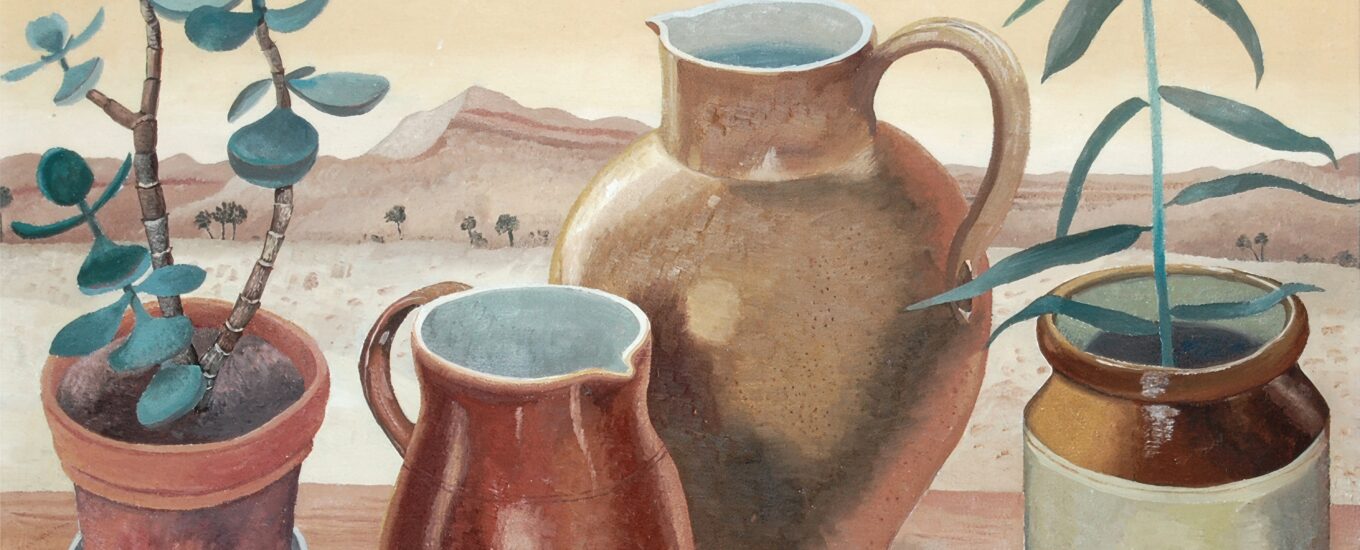
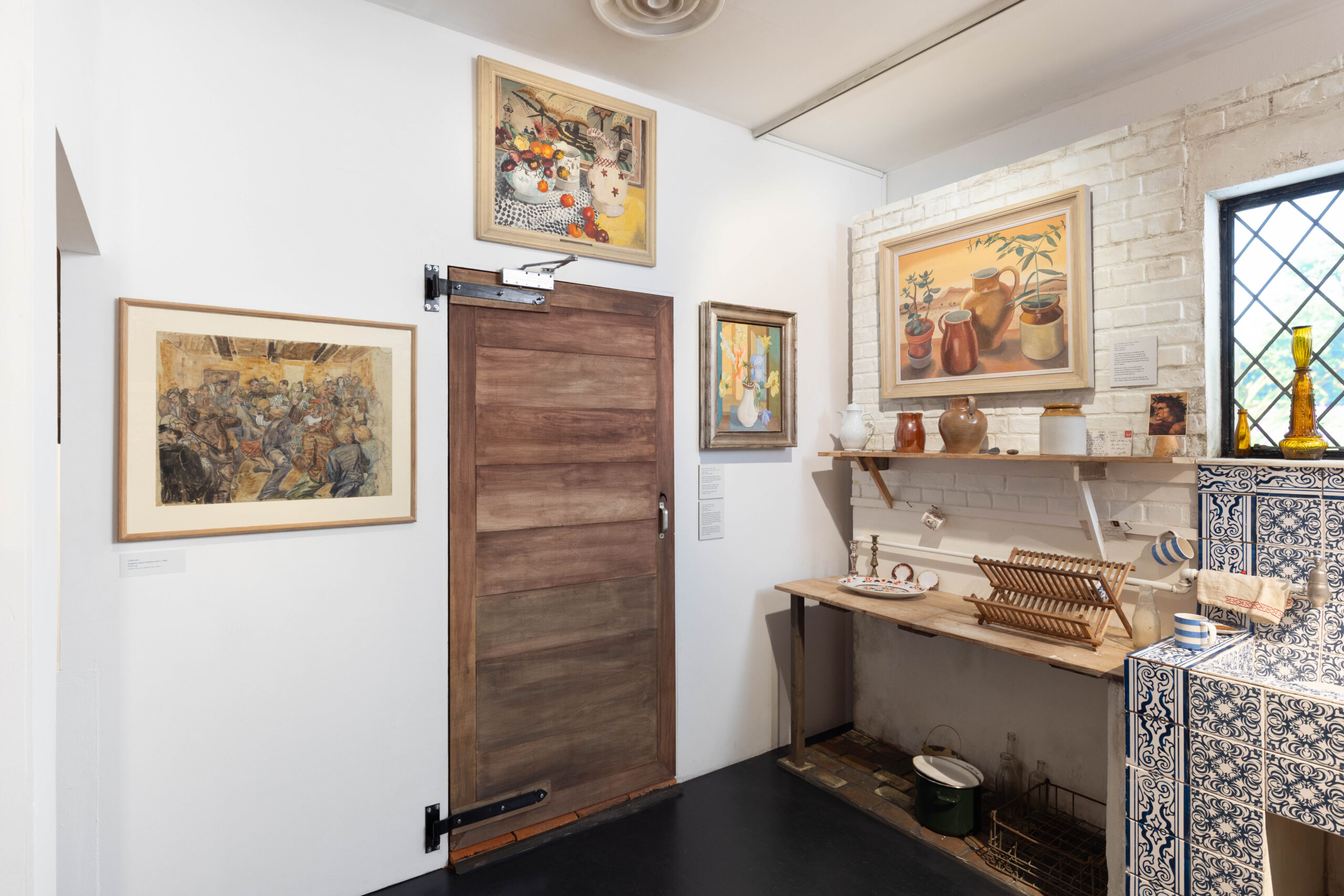
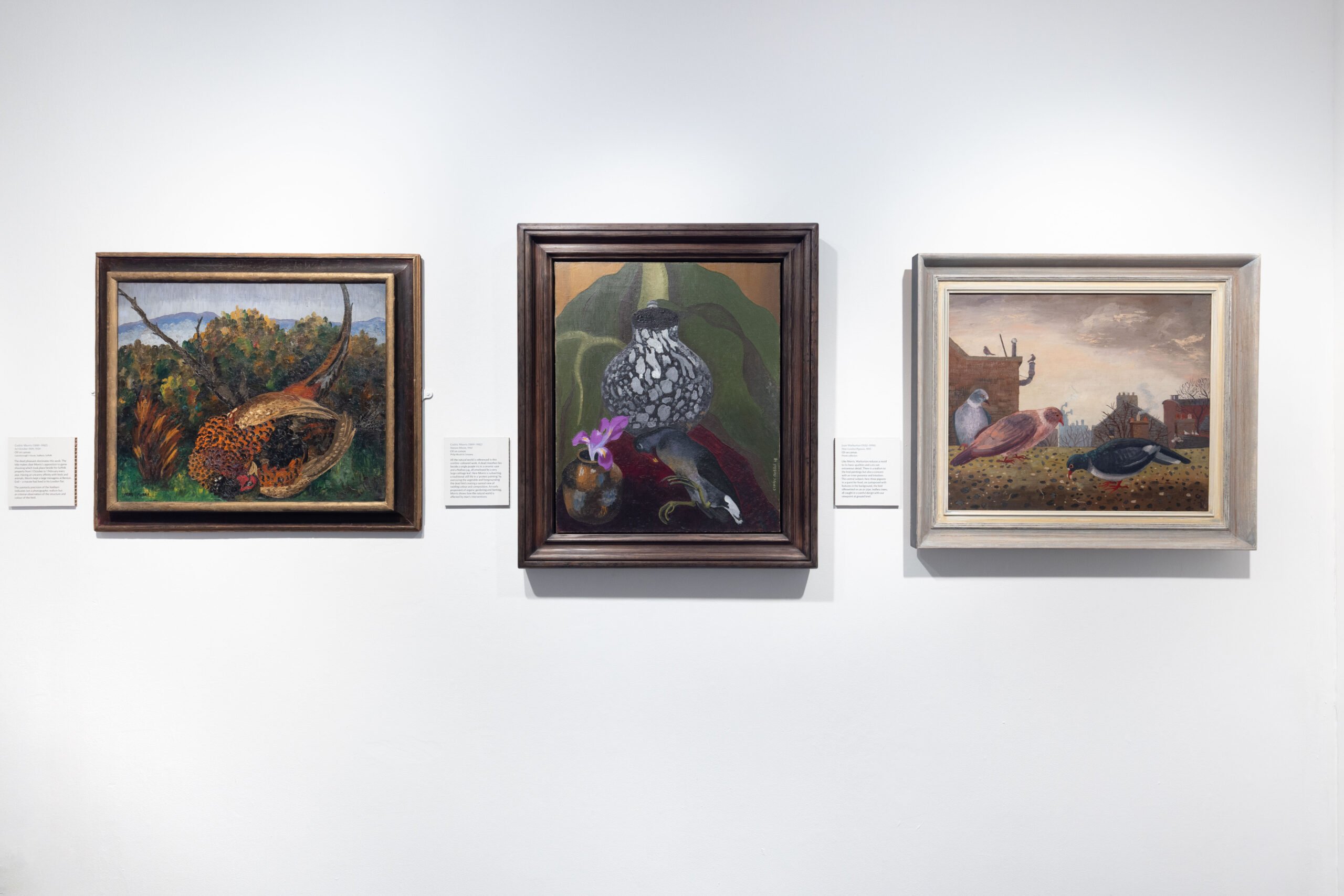
Nine London Pigeons, 1957, is a painting which indicates an influence from Morris in an intense love and understanding of the natural world but also shows Warburton’s specific take on it. Like Morris, Warburton reduces a motif to its basic qualities and cuts out extraneous detail. There is a realism to this bird painting but also a concern with an inner presence and intuition. The central subject, here three pigeons in a quest for food, involves the viewer in this struggle through the ground level viewpoint to obtain food in a hostile environment, and juxtaposes these central pigeons with background birds, such as the bird silhouetted on an air pipe, as well as leafless trees, all caught in a careful design. And Still Life in a Desert, 1956, on display in the kitchen section of the exhibition, is a boldly painted work, beautifully capturing the golden brown tones of the ceramic ware, also on display, so visitors can compare the reality with the painted works.
While I was researching Warburton’s life and career, and peering over photographs in which she appears as a key figure in a tight knit circle of students in the early days of Benton End in the 1940s, (and possibly sparked by the fact that her father had been in the army), the poem A Subaltern’s Love Song by John Betjeman sprang to mind. Betjeman, dreaming about an imagined game of tennis in Aldershot with J. Hunter Dunn to whom he becomes engaged, bases the poem on a real figure called Joan Hunter Dunn whom he had seen when they were both working in the Ministry of Information in 1940. Despite being married for seven years he composes one of his most celebrated poems celebrating this vision; his literary creation had the speed of a swallow, the grace of a boy, a special tilt of her nose and a chime of her voice, all of which definitely resonated with the figure of Joan Warburton captured in these sunlit photographs of Benton End.
Benton End: A Paradise of Pollen and Paint is open until 20 September 2026.