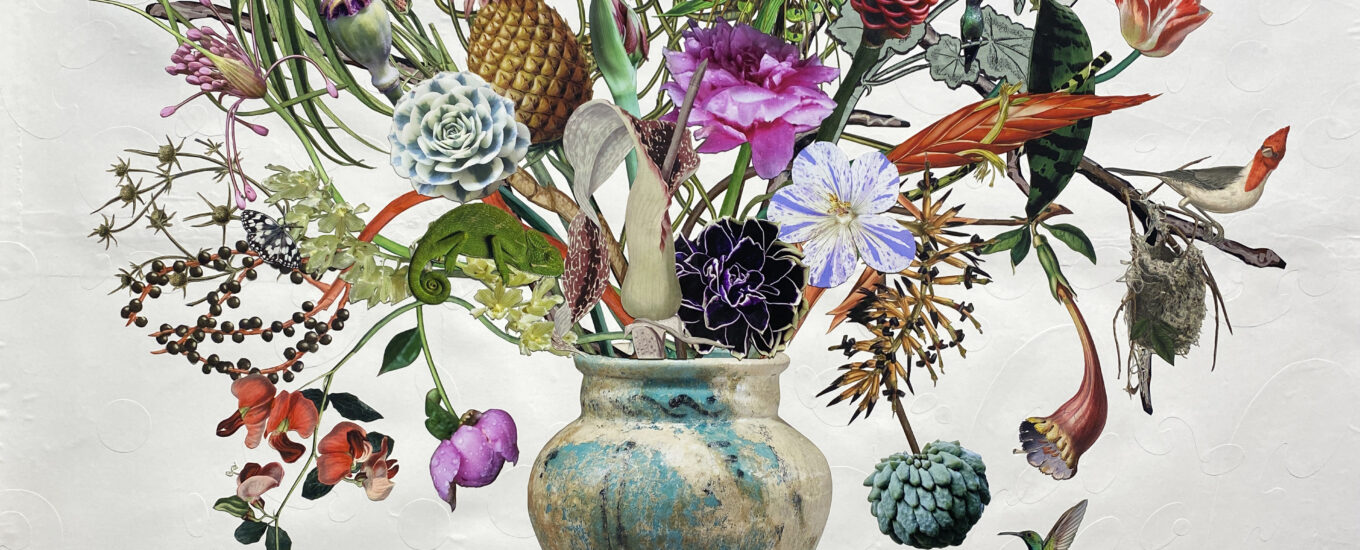
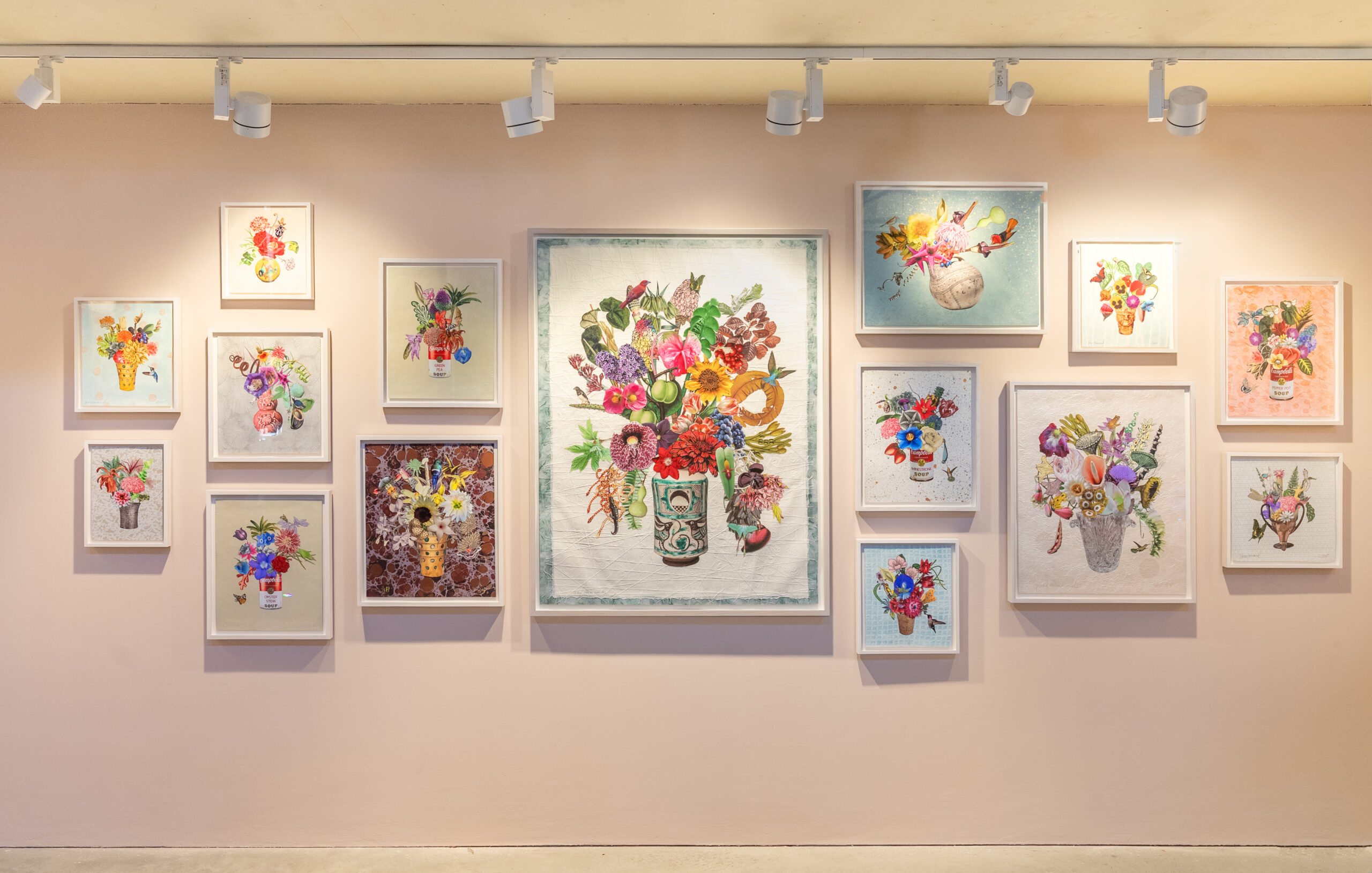
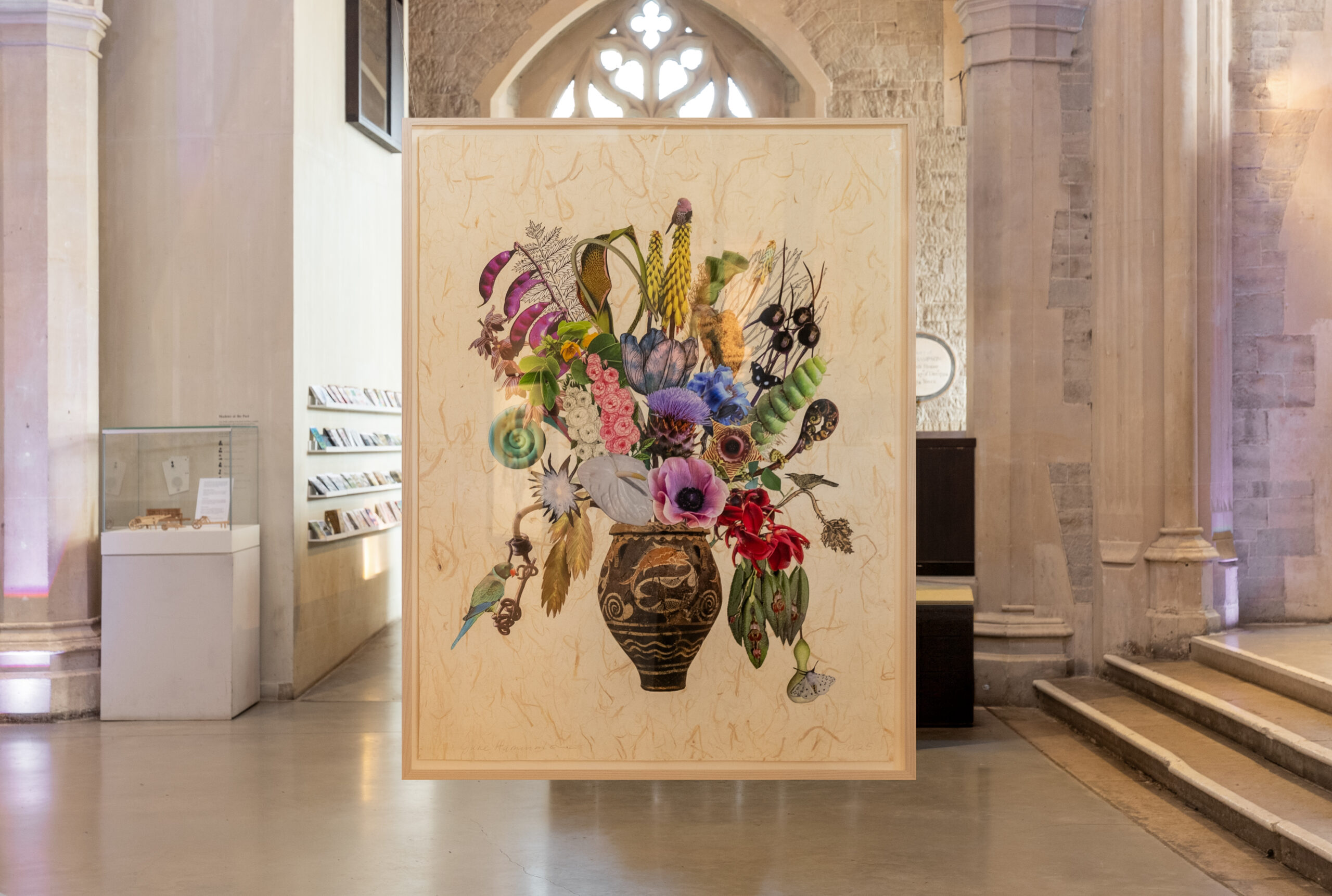
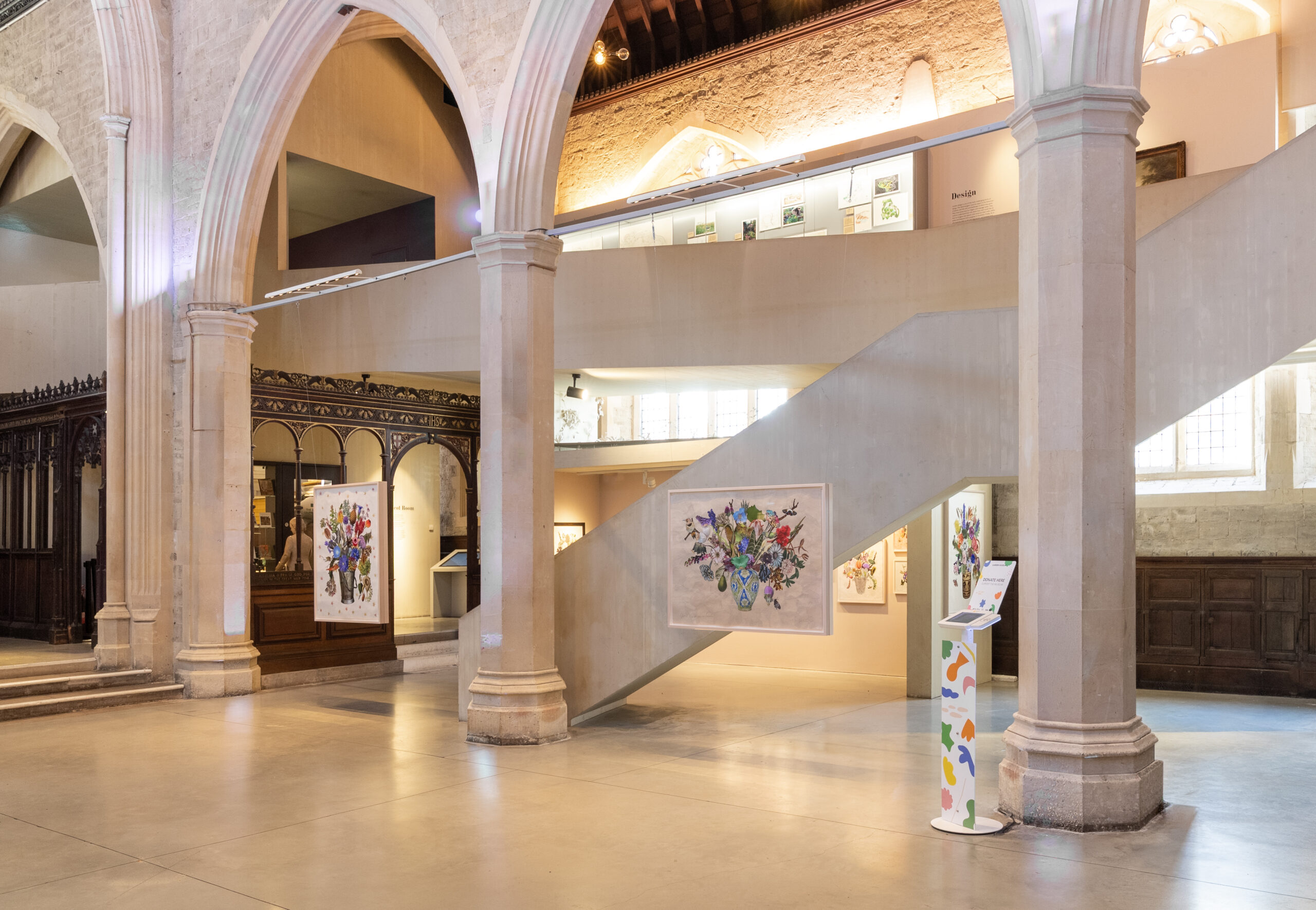
Jane Hammond's botanical collages mix drawing, painting, photography, recycled objects and digital elements to create vibrant displays of plants, flora and fauna. While her exhibition is on display at the Garden Museum in partnership with Lyndsey Ingram, we asked Jane a few questions to find out more about her work.
Tell us about yourself, and what was your journey to becoming an artist?
I grew up in and around nature. From my childhood home you could not see another home. We had a pond, a swamp, fields, woods, lawn, a barn with chickens, rabbits, briefly a horse. Many dogs, always two or three or four, once 19 (two simultaneous litters of puppies.) My Grandmother was young, 42 when I was born, she gardened seriously. When I was six she made me memorize the Latin names of 100 flowers.
Your new exhibition at the Garden Museum Angel’s Trumpet, Adder’s Tongue is an impressive series of mixed-media botanical collages. How did you develop this series, and what is your process for creating them?
I did not see this body of work, the botanical collages, coming. I was always interested in plants but I assiduously kept it out of my fine art. I came of age as an artist in a time when beauty, nature, flowers, any of that was seriously frowned upon.
To be brief, a museum curator who had been very supportive of my work asked me to participate in making an edition of prints as a benefit for her acquisitions program. This was Nancy Sojka, Print Curator, at the Detroit Institute of Arts. I made the first botanical collages, thinking this would be a good project for this charity. Once I made the first ones I was hooked.
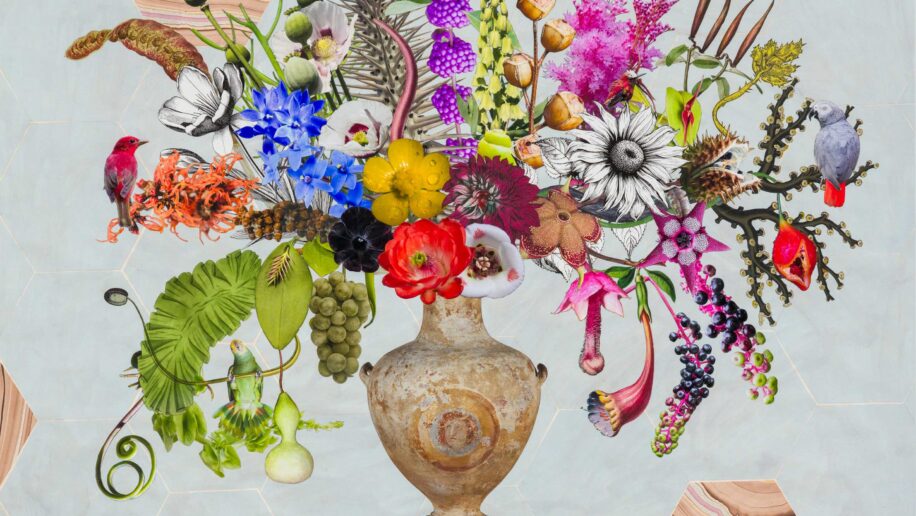
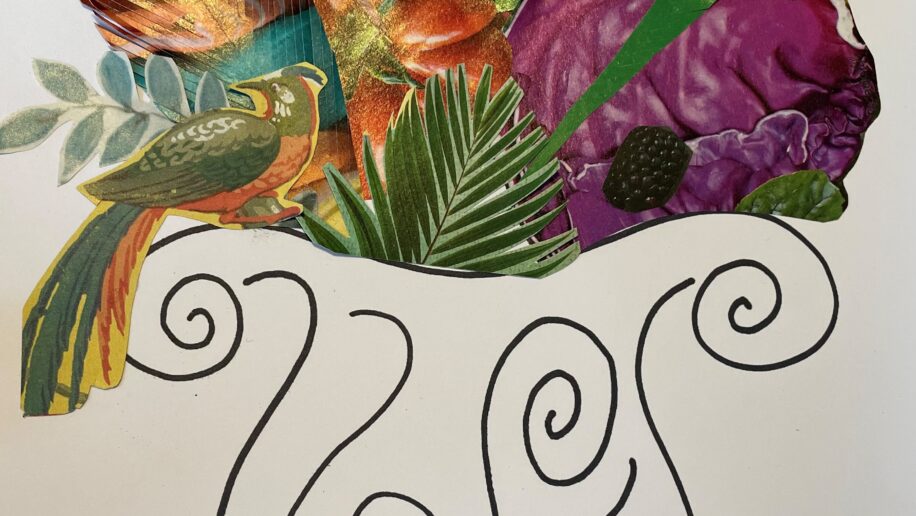
The basic premise was to make the image the same way one would make an actual arrangement: to procure a vase, then create a huge surfeit of plant and plant adjacent materials, then begin to arrange these elements inside the vase. The opposite of this would be illustrating a pre-arranged existing composition. My compositions are not iterative of something else, they are the first order reality of themselves.
Can you tell us more about the flowers, plants and wildlife in the collages?
There are flowers and plants and animals I am familiar with and have feelings for, for example I spent a lot of time as a child catching turtles and frogs. But the range of things in this work is much much broader than my own experience.
It’s hard to analyze what draws me to something: it could be pattern, say the markings in a calico flower, it could be structure, say the way a coral branch is organized or the shingling angles of the Monkey Puzzle Tree, it could be colour, say the incredible blue of Meconopsis, the Himalyan Blue Poppy.
Occasionally I’ll even use something I like fairly well but I love the name of it, say the Sugar Glider. I’m collecting things now that have numbers in their title (which is, I believe, for descriptive utility) – the four leaf cover, the five-lined Skink, the six-spotted Tiger Beetle, etc. I have a lot of different conceptual nets with which I scoop up flora from the Universe.
Do you have any favourite works in the exhibition?
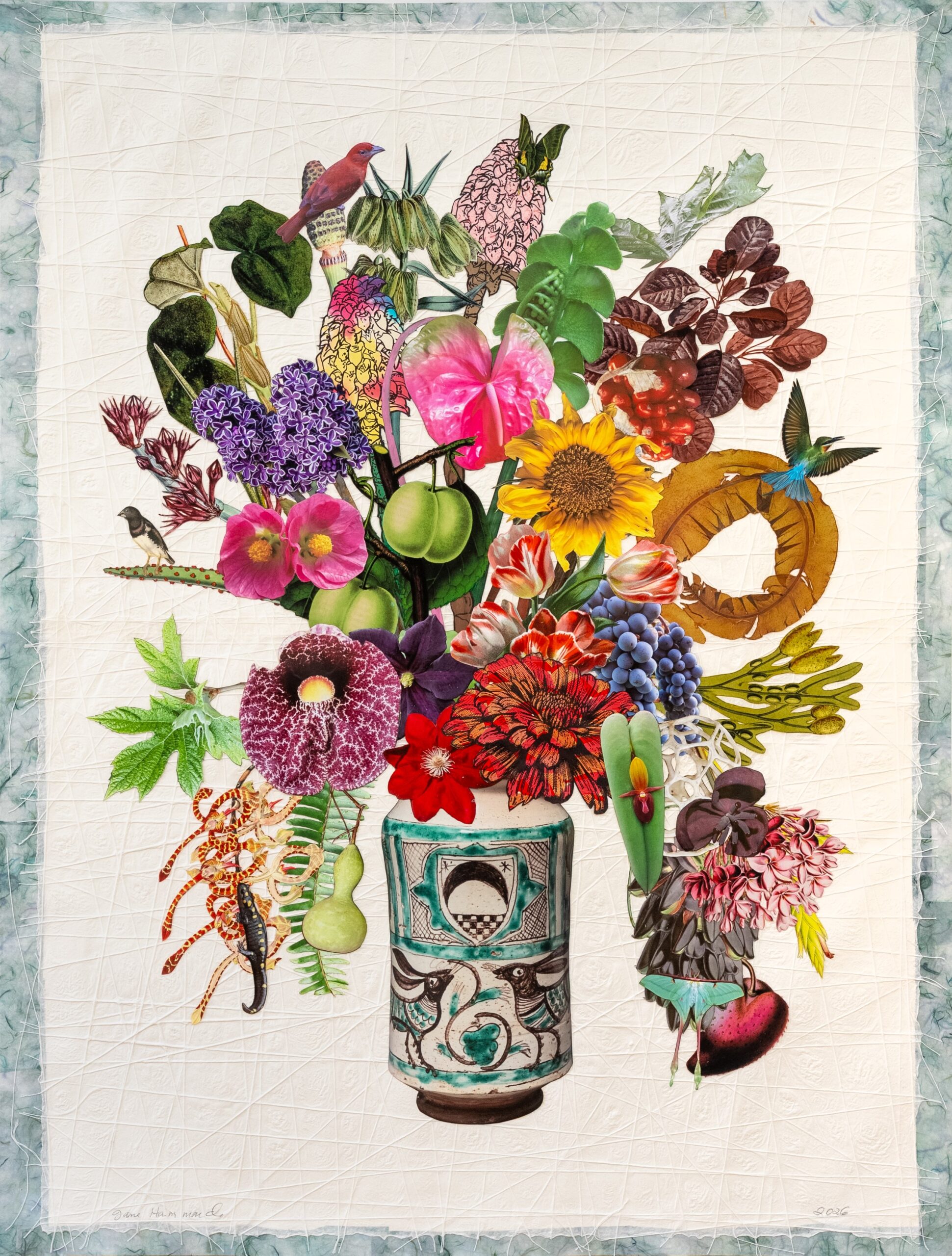
Right now I’m very high on the piece entitled Spanish Albarello with Spotted Salamander, Lilacs and Seaweed. I love the way the ground worked out, the relationship between the strings imbedded in the paper and the diagonal grid design on the jar, atop the rabbits. I love how the salamander is climbing up the orchids and how that pairs with the gourd dangling on the fern. I am delighted by the idea of lilacs and seaweed together – just the smells.
However, I have to admit this is the most recent large piece and I’m often most in love with my last endeavor, until it becomes displaced by its successor!
Beyond these collages, your work covers a fascinating variety of materials and mediums, how do you decide where your next project will take you?
Yes, I have an extremely diverse project. I would wager that if you Googled me and probed into my black and white photography it would take you a while to find connections between my photography and my botanical collages.
An honest answer would be, that it is partly that I am in charge and partly that I am led by my instincts and my “calling” if you will. In terms of the first idea, I am committed to the concept that art is about creativity and discovery. It is not about repetitions, recognizability and sameness – that is the prison of the recognizable style, that is what the market wants an artist to be.
The artist’s job, in my humble opinion is to resist those forces and commit to a process of discovery, exploration and continual unconscious wandering into new realms, continual learning. With those ideas as a background, I would say that I don’t really decide where my next project will take me and when it will happen. I’m a sailor who can manage a boat, but I don’t control the wind.
What does a typical day in the life of an artist look like for you?
Starting backwards, at night I research for new things: new plants, new birds, I’m always on the hunt. During the day I’m mostly working. The botanical collages and nearly everything I do is quite labour intensive, this is somehow how I am wired.
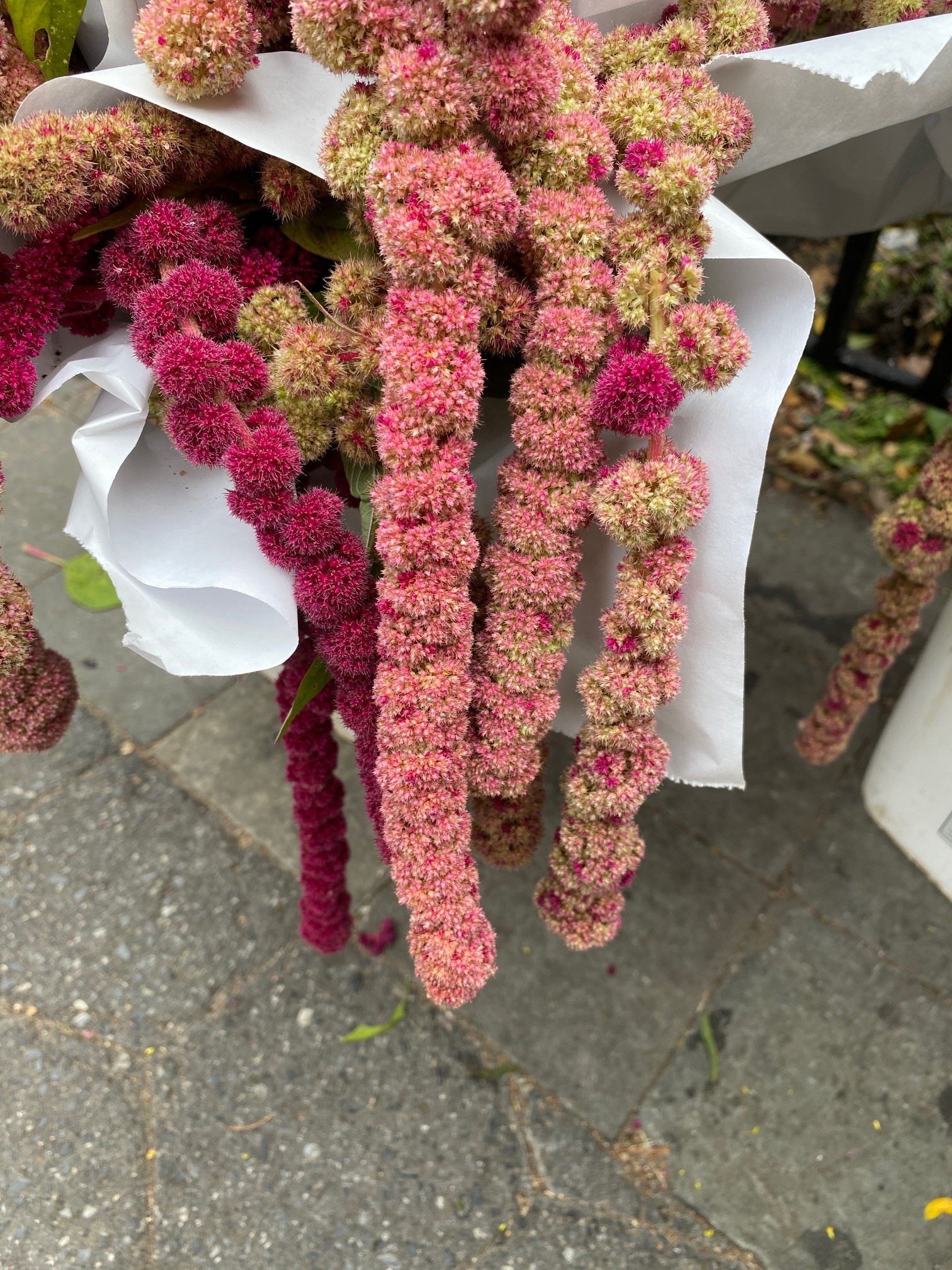
Of course Saturday mornings I always go to the farmer’s market. Ostensibly this is for food shopping but I have taken a lot of pictures there (“Do you mind if I take a picture of your Fritillaria persica?”) and occasionally I’ll buy things (a bunch of Japanese Knotweed, bright green with purple splotches) that I only intend to use for the botanicals, either to paint a version of it, or to photograph it. I’m not planning to eat it.
When you’re not making art, do you have any favourite gardens to visit or places to immerse yourself in nature?
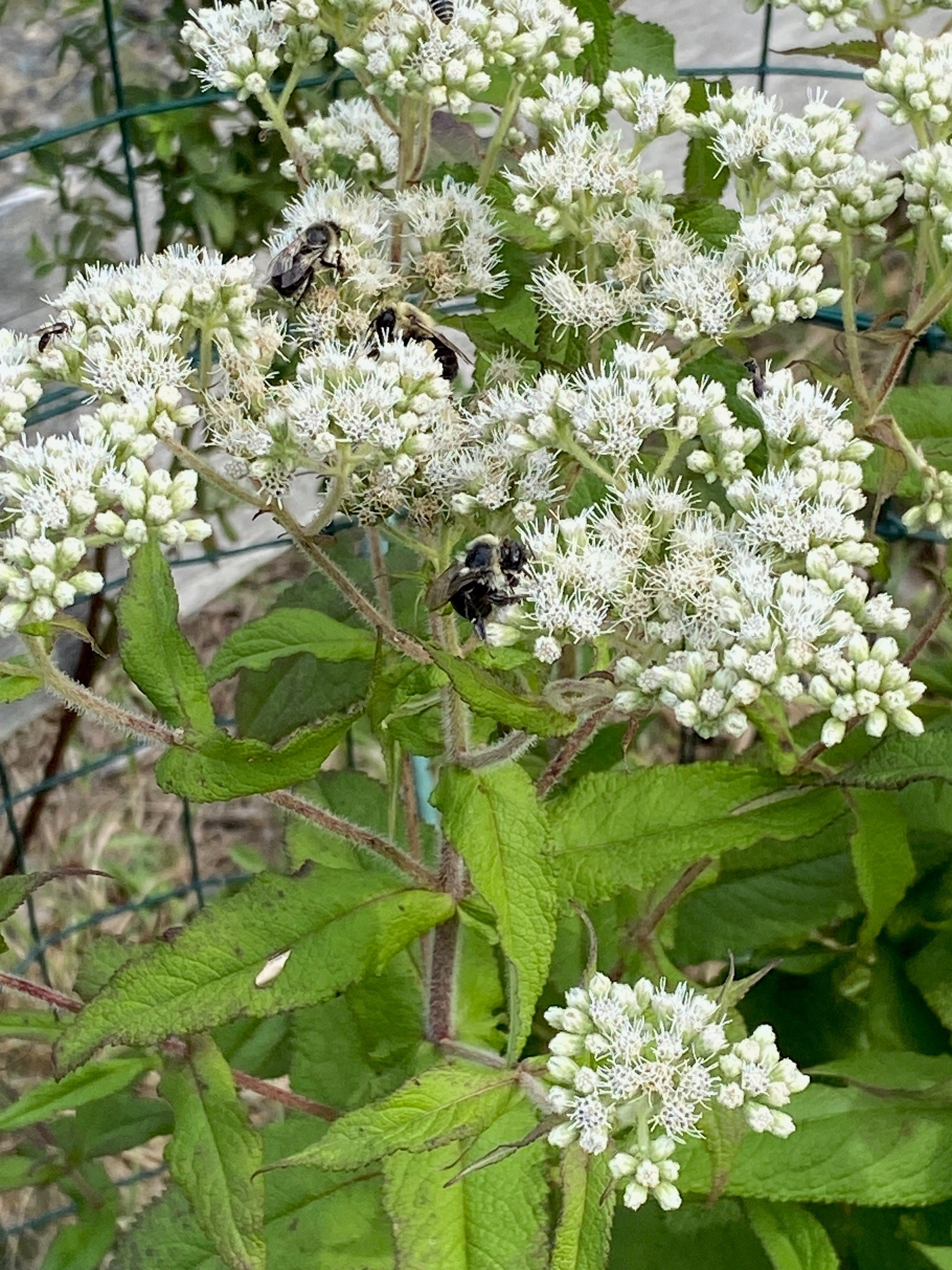
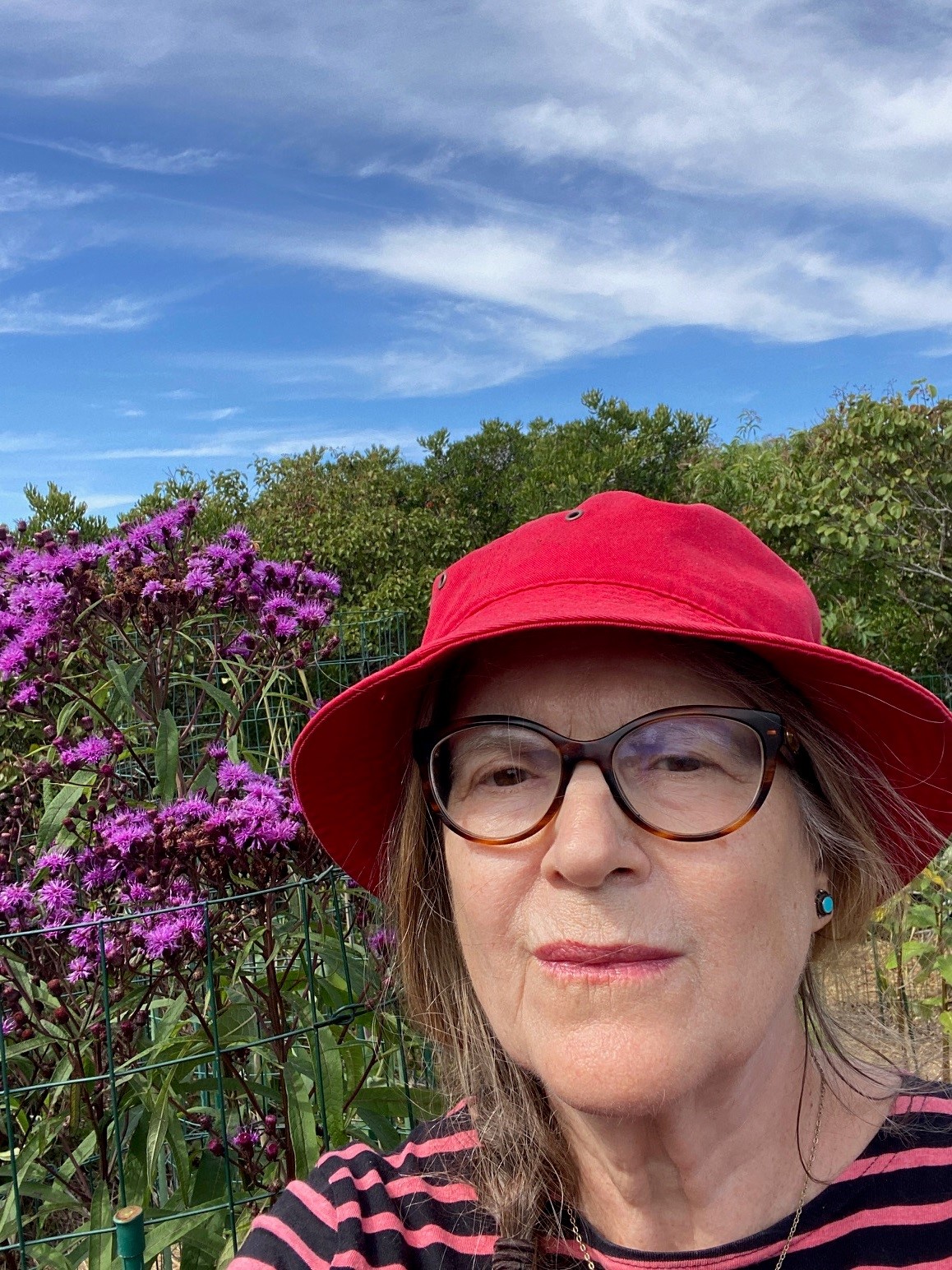
I have started a pollinator garden in Nantucket, as of five years ago. It is in an old road bed (the town applied layers of clay and gravel, and ran big graders and dump trucks over it) so the soil is difficult, the digging is brutal and on top of that, the deer are rapacious.
Nevertheless I am getting somewhere and I love working on it and learning about new native plants. My new favorite is Ironweed (Veronia Novaborasensis).
Finally, as we are the Garden Museum, can you tell us about your own relationship with plants, gardening and nature?
In your bookshop is my brand new book entitled Chocolate Cosmos, String of Pearls and in it I write an essay about the importance of plants, specifically plant-looking.
My thesis is tough to encapsulate, but basically I think it is plants who taught us how to look and how to link up visual information with cognition and critical thinking – human thinking. I think plants are sublimely important to who we are, way more important than concepts of “mere” beauty and pleasure get at. They are the metier that taught us how to compare and comparison is the basis of all discernment.
Jane Hammond: Angel’s Trumpet, Adder’s Tongue is open until 24 May 2026
In partnership with Lyndsey Ingram
 Free
Free
 Free
Free
 Free
Free