Alec’s Ark: Remembering Alec Cobbe (1945-2026)
news
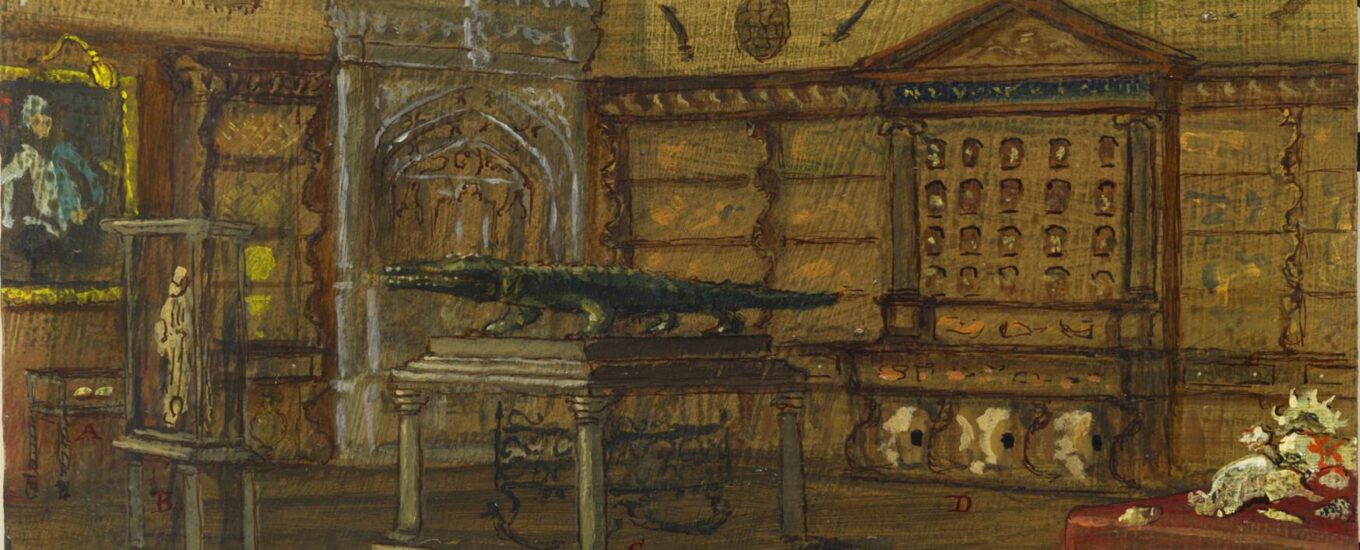
Concept sketch for the Ark Gallery by Alec Cobbe
‘This is one for Alec Cobbe’ said Caroline Egremont, our Trustee. ‘Let me ask him’. In 2015 we had decided to build the Ark Gallery dedicated to John Tradescant’s lost 17th century collection; the museum was founded, of course, to preserve the site of the great gardener’s burial in 1638. It’s a deep and precious chamber, which will shortly have the Mortlake tapestry hung on one wall.
Alec’s skill as a designer and knowledge as an historian makes you forget how odd a commission it was. The actual Ark was an extension which Tradescant added to his house in Lambeth added in the 1620s and long demolished; the new gallery was the empty chancel of the derelict church of St Mary’s, where Tradescant happened to worship. The collection displayed in The Ark had been bequeathed to the Ashmolean Museum at Oxford at the death of Tradescant’s son; what was on display had been in Oxford since 1683 and would be on long-term loan. We needed precision – but, also, imaginative flair.
And so Caroline took us to Hatchlands in Surrey to see Alec Cobbe’s studio as a designer and paintings restorer but also the Newbridge Cobbe Museum of Curiosities, an 18th century family collection which he had inherited and re-located from Newbridge House in Ireland. Its curiosities include a boomerang brought back by Captain Cook; as a Curator, I was as interested in the construction of a glazed showcase which survived from that time. In 2015 Yale University Press published a superb book on the Cobbe Collection, edited by Arthur MacGregor).
As obituaries have described, Cobbe trained first as a doctor before becoming a picture conservator at Tate, and from the 1980s designing interiors and picture hangs for country houses; the King James drawing room at Hatfield House is a masterpiece, with Renaissance pictures hung boldly on to tapestries.
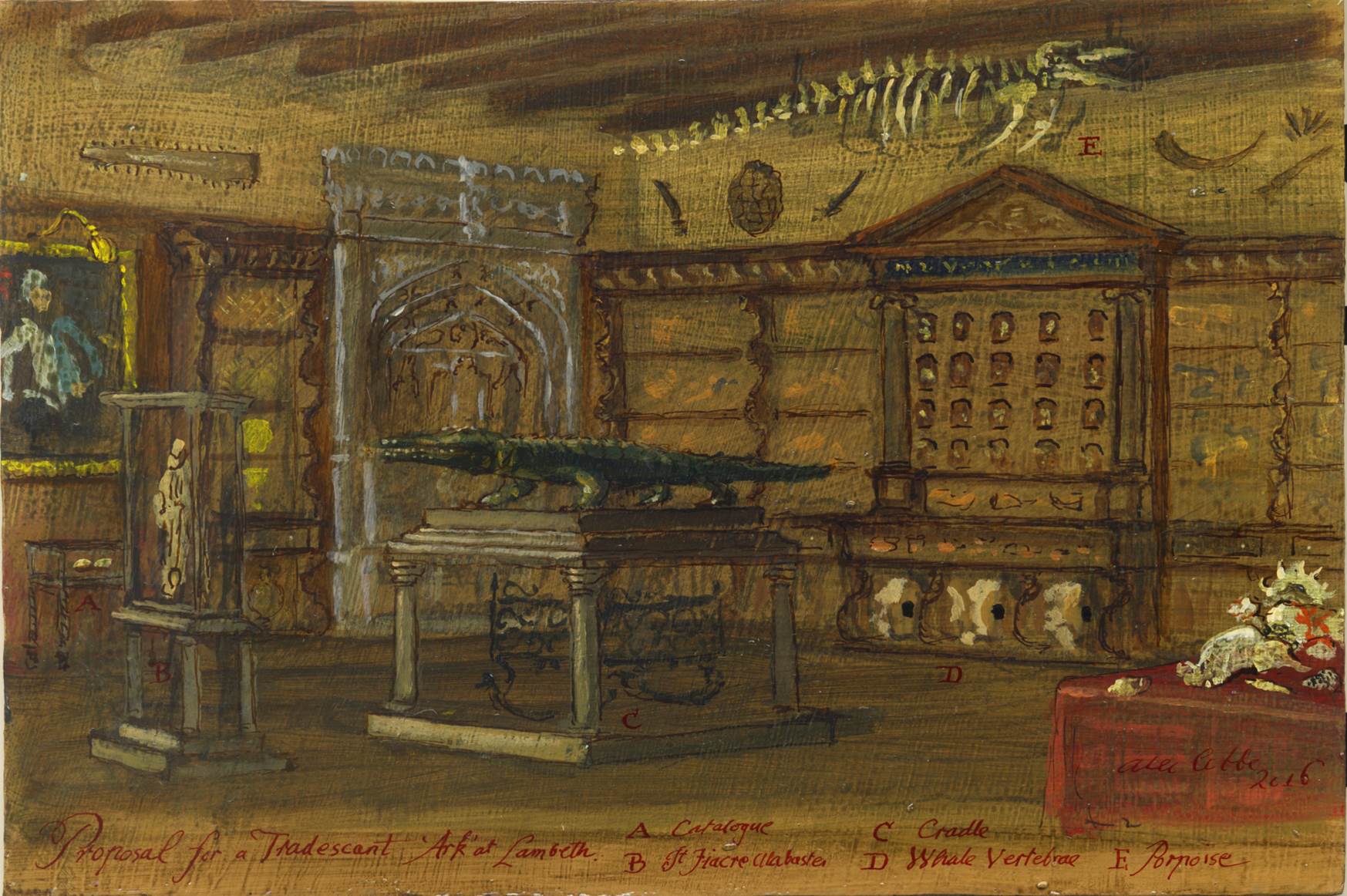
Concept sketch for the Ark Gallery by Alec Cobbe
Alec dug very deeply into the research: there were no visual records of Tradescant’s Ark, and the only visitor’s account simply referred to a ‘long low room’. Every article on 17th century Cabinets of Curiosities is illustrated by a 1620 engraving of Ole Worm’s Cabinet in Copenhagen; it’s a captivating image but there is no reason to believe that Tradescant’s Ark would look anything similar. What, we wondered, would the spec have been for a gardener’s Museum, even a star gardener such as Tradescant? Alec took the mouldings of the upper chamber in the Royal Observatory in Greenwich as the base for his design. At the same time that model had been adapted to all the technical requirements of a priceless modern collection: the joinery is fitted around showcases which meet the highest standards for climate control. It is a very special room to step into.
For a long time I kept the sample of a glazing bar on my office shelf. I didn’t realise why I hung on to it until now. That slim, elegant piece of wood seemed to carry the tensile strength of a unique mind.